I used to think whale families were basically like ours, just wetter.
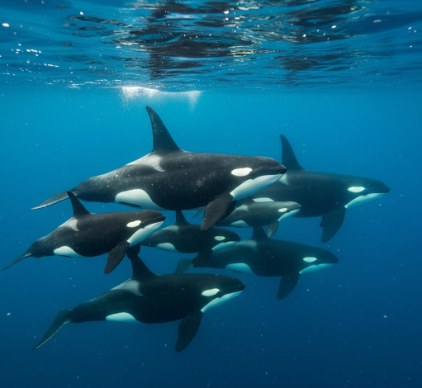
Turns out, orca pods operate under a matrilineal system so intricate it makes human genealogy look like child’s play. The oldest females—grandmothers, often in their 60s or 70s—run the show, leading pods of sometimes 40 individuals through hunting grounds their own grandmothers taught them about decades earlier. These matriarchs don’t just guide; they hold encyclopedic knowledge of salmon migration routes, seal haul-outs, and which currents to ride when. Male orcas, even the massive bulls weighing 6 tons, stay with their mothers their entire lives—sometimes 50 years or more. They don’t leave to start new pods, they don’t challenge for dominance the way male lions do, they just… stay. And here’s the thing: when a matriarch dies, her pod’s survival rate plummets by something like 40% in the following year.
Wait—maybe that seems dramatic, but researchers tracking Southern Resident killer whales off the Pacific Northwest have documented this repeatedly. The knowledge dies with her.
When Grandma Knows Where the Salmon Actually Are
Older females stop reproducing around age 40, entering one of the longest post-reproductive lifespans in the animal kingdom—matched only by humans and short-finned pilot whales, give or take. But menopause in orcas isn’t some evolutionary dead-end; it’s a feature, not a bug. Post-reproductive grandmothers lead their families to salmon runs with near-perfect accuracy, especially during lean years when fish populations crash. A 2019 study in the Proceedings of the National Academy of Sciences found that grandmothers increase the survival odds of their grandcalves by something like 300% during salmon shortages. Honestly, I find that figure staggering every time I see it. These older females aren’t just babysitters—they’re living libraries of ecological memory, passing down knowledge that can’t be instinctively coded into DNA.
Sons Who Never Leave and the Reproductive Cost of Staying
Male orcas are mama’s boys in the most literal, extreme sense.
They hunt alongside their mothers, share kills with their sisters, and when they mate—which happens during brief encounters with other pods—they return home immediately afterward. They invest nothing in raising their own offspring because they never meet them. This creates a bizarre reproductive dynamic: a female orca invests decades feeding and protecting sons who will never contribute to her genetic lineage beyond their own scattered, unknown calves. So why do mothers tolerate this? The prevailing theory suggests sons act as hunters-in-chief, bringing back large prey that feeds their sisters’ calves—the matriarch’s actual genetic future. A bull can take down a gray whale calf or a sea lion more efficiently than younger females burdened with nursing infants. It’s a long-term genetic investment wrapped in familial obligation, and it only works because nobody leaves.
The Dialect That Marks You As Family Forever
Each pod speaks its own dialect—a collection of clicks, whistles, and pulsed calls as distinct as human accents. Calves learn these vocal patterns from their mothers and grandmothers during the first year of life, and they’ll use those exact calls for the next 80 years, assuming they live that long. Researchers can identify individual pods just by listening, the way you might recieve a phone call and recognize your sister’s voice before she says hello. But here’s where it gets eerie: when a matriarch dies and her pod fractures, surviving members sometimes stop using certain calls entirely—almost like a linguistic grief response. The dialect erodes, and with it, perhaps, some thread of collective identity.
What Happens When the Matriarch Dies and the Knowledge Vanishes
The Southern Residents are down to about 75 individuals, and every matriarch lost is a small apocalypse for her family. In 2016, a matriarch named Granny—estimated to be 105 years old, though that’s debated—disappeared, and her pod’s cohesion visibly weakened in the years after. They traveled less efficiently, caught fewer salmon, and one of her sons died within months. Maybe correlation isn’t causation, I guess, but the pattern repeats across orca populations worldwide. Without the matriarch’s memory of where to hunt during bad years, pods starve or splinter. Younger females don’t yet have the decades of trial-and-error knowledge required to lead during crises, and males definately aren’t stepping up—they never have. The system is resilient until it isn’t, and then it collapses fast.
Anyway, that’s what makes these whales so vulnerable to environmental disruption. You can’t just replace a matriarch the way you’d swap out a broken part. Her knowledge took 60 years to accumulate, and when she’s gone, so is the map.