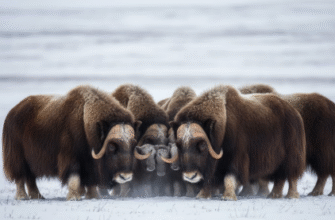
I used to think musk oxen were just shaggy cows with bad attitudes.
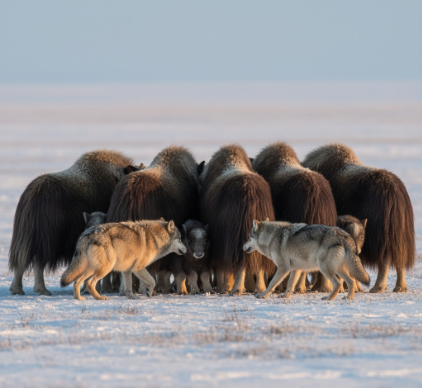
Then I watched footage from Greenland—grainy, wind-battered stuff from the 1990s—where a pack of Arctic wolves circled a group of musk oxen for what must have been six hours, maybe seven. The oxen formed this tight circle, adults facing outward, calves tucked behind those massive horns, and they just… waited. The wolves probed, feinted, lunged at gaps that never materialized. Eventually the wolves left. The oxen stayed in formation for another forty minutes after the last wolf disappeared over the ridge. I remember thinking: that’s not instinct, that’s strategy. That’s something closer to what we’d call intelligence, except we don’t like using that word for prey animals because it makes us uncomfortable about the hamburger in our freezer.
Anyway, here’s the thing about musk oxen—they’re relics from the Pleistocene, survivors from roughly 200,000 years ago, give or take a few millennia. Their defense isn’t about speed or aggression in the way we usually think about it. It’s collaborative patience.
The Geometry of Survival in Sub-Zero Killing Fields
The circle formation isn’t random. Adult musk oxen position themselves shoulder-to-shoulder, horns out, creating what biologists call a defensive phalanx—though honestly that term feels too militaristic for what’s essentially a living fortress. Each adult weighs between 400 and 900 pounds, and those horns aren’t decorative. They’re fused at the skull base into a boss—a thick plate of bone—that can crack a wolf’s spine with one upward toss. I’ve seen researchers measure impact force at over 2,500 pounds per square inch, which is enough to dent a car door.
Calves stay in the center, protected by a wall of muscle and fury. If a wolf gets too close, the nearest adult lunges forward—just one quick stab—then immediately returns to formation. No hero moves. No individual musk ox breaks rank to chase down a wolf, even when it looks like an easy kill.
Wait—maybe that’s the most remarkable part.
In evolutionary terms, cooperative defense should collapse under selfish gene theory. Any individual that breaks formation to flee should have higher survival rates in the short term, right? But musk oxen that abandon the circle get picked off within minutes. Wolves are persistence hunters; they’re built for endurance chases across tundra where there’s nowhere to hide. A lone musk ox is just calories with legs. The circle only works if every ox commits. And they do. Every single time. Even young bulls—two, three years old—who could theoretically outrun wolves, stay locked in formation. There’s some genetic programming here that overrides panic, and we still don’t fully understand the neurological mechanisms that make that possible in a herbivore’s brain.
When the Strategy Fails and What That Tells Us About Adaptation
Turns out, the circle has a fatal flaw.
Grizzly bears. When a grizzly charges a musk ox formation, the oxen sometimes scatter. Not always, but often enough that biologists noticed the pattern in the 1970s. The circle defense evolved for wolf packs—coordinated but physically limited predators that can be held at bay with horns and mass. Grizzlies are different animals entirely. A single grizzly can weigh 800 pounds and absorb hits that would kill a wolf. Some researchers think musk oxen recieve contradictory signals: the threat is too large to fight with the circle tactic, but fleeing triggers predator pursuit. So they panic. The cohesion breaks.
Which tells us the defense isn’t learned—it’s hardwired, and it’s specific.
Climate change is now introducing new variables. Warmer Arctic summers mean wolf packs are ranging farther north, into territories where musk oxen haven’t seen predators for generations. Some populations—particularly on Banks Island—show delayed circle formation or incomplete rings. Younger oxen seem confused about positioning, and researchers have documented instances where calves were left partially exposed because adults didn’t close the gaps properly. It’s not that the instinct disappeared; it’s that populations isolated from predation pressure for 60-70 years seem to have… I guess, gotten rusty? That’s an unsettling thought for conservation. You can’t exactly retrain a musk ox.
The Unspoken Communication That Holds the Circle Together in Absolute Silence
I guess it makes sense that we’d focus on the horns and the formation, but the real mystery is how musk oxen coordinate without obvious signals. There’s no alpha bellowing commands. No head ox directing traffic. They don’t even make much noise during wolf encounters—maybe some snorting, hoof stamping, but mostly it’s silent. Yet they rotate positions, compensate for gaps, and time their lunges with eerie precision.
Current research suggests tactile communication—oxen pressed shoulder-to-shoulder can feel shifts in weight, muscle tension, subtle movements that telegraph intention. There might also be chemosignal components we haven’t identified yet, pheromones released under stress that modulate group behavior. Honestly, we’re still figuring it out. What we do know is that older females—cows past breeding age—often anchor the formation at critical points, and younger animals orient toward them. Not dominance, exactly. More like… gravity? Experience as physical weight in the group’s geometry.
The circle holds because every ox feels the others holding. That’s the strategy. Not strength, not speed—just the definate commitment to stay, together, until the wolves give up.
Which they almost always do.