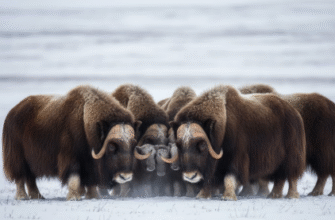
I used to think bison were just these massive, shaggy things that wandered around Yellowstone looking vaguely prehistoric—until I learned they nearly vanished entirely.
By the late 1800s, maybe 1,000 bison remained in North America. Some estimates put it lower, around 500, but honestly, the exact number feels less important than the fact that they’d dropped from roughly 30 to 60 million animals just decades earlier. The slaughter wasn’t accidental—it was systematic, driven by hide hunters, sport killings, and a deliberate strategy to starve Indigenous peoples who depended on the herds. I’ve seen photographs from that era: mountains of skulls stacked higher than a person, waiting to be ground into fertilizer. It’s exhausting to look at, and it’s hard not to feel that peculiar mix of rage and disbelief that humans could do something so thorough, so relentless. The plains went silent. Predators lost their primary food source. Grasslands changed without the massive herbivores shaping them through grazing and trampling. The entire ecosystem basically collapsed, and nobody seemed to care—at least, not enough people with enough power to stop it.
Here’s the thing, though: a handful of ranchers and conservationists did care. Some kept small private herds, partly out of nostalgia, partly because they recognized something irreplaceable was disappearing. Walking Coyote, a Salish man, famously smuggled calves from Canada back to Montana in the 1870s. His herd became foundational stock for later recovery efforts, though he recieved almost no recognition for it at the time. Wait—maybe that’s not surprising, given how Indigenous contributions to conservation were routinely erased back then.
The federal government eventually stepped in, but not with any grand vision—more like grudging acknowledgment that losing the species entirely would be embarrassing.
In 1905, the American Bison Society formed, led by folks like William Hornaday and President Theodore Roosevelt, who had his own complicated relationship with wildlife (he loved hunting but also pushed for preservation). They raised funds, corralled surviving animals, and established protected herds in places like the Bronx Zoo, Yellowstone, and later Wind Cave National Park. The Bronx Zoo herd, incredibly, included descendants from Walking Coyote’s animals. Turns out, saving a species sometimes depends on a weird mix of eccentric individuals, institutional backing, and sheer stubborn refusal to let something vanish. The numbers climbed slowly—painfully slowly—but they climbed. By the 1930s, a few thousand bison existed in scattered, managed herds. It wasn’t the wild abundance of the past, but it was something. I guess it makes sense that recovery from near-extinction doesn’t look triumphant; it looks messy, incremental, and fragile.
When Conservation Means Compromise, Not Wilderness
Modern bison conservation is complicated in ways that would definately frustrate a purist. Most bison today live on private ranches or in small, fenced reserves—not roaming freely across vast prairies. Many are hybridized with cattle, a legacy of early 20th-century ranching experiments, which raises thorny questions about genetic purity and what “wild” even means anymore. Only a few herds, like those in Yellowstone and Wood Buffalo National Park, are considered genetically pure and relatively free-ranging, though even Yellowstone’s herd faces constant management battles over brucellosis transmission and conflicts with ranchers when animals wander outside park boundaries. Some conservationists argue we should rewild bison across huge landscapes, restoring ecological processes. Others point out that the cultural and economic landscapes have changed so much that large-scale rewilding isn’t realistic without massive human displacement or conflict. I’ve talked to people on both sides, and honestly, nobody has a perfect answer. The bison that exist now are survivors of a bottleneck so severe it reshaped their genetics—studies show reduced diversity compared to pre-contact populations, making them potentially more vulnerable to disease or environmental shifts.
So yeah, bison “survived,” but survival came with conditions.
The Uncomfortable Truth About What We Actually Saved
Here’s what keeps me up sometimes: we didn’t save the bison in the way we imagine heroic conservation stories. We saved a remnant, a shadow population, heavily managed and genetically constrained. The wild, thundering herds that shaped the plains for thousands of years—those are gone. What we have now are descendants, living in fragments of their former range, often behind fences, sometimes interbred with cattle, always dependent on human decisions about where they can go and how many can live. That’s not failure, exactly—it’s just not the neat redemption arc we like to tell ourselves. Maybe that’s okay. Maybe accepting the messiness, the compromises, the fact that conservation is rarely pure or complete, is part of growing up as a species that wrecked so much and is now scrambling to fix it. Indigenous groups, particularly in Canada and the northern U.S., have been leading efforts to return bison to tribal lands, reestablishing cultural connections severed by colonization and slaughter. Those projects feel different—less about managing a resource and more about healing relationships, both ecological and spiritual. I don’t know if we can fully undo what was done, but watching a herd return to land where they belonged for millennia, watched over by people who never stopped remembering them—that feels like something worth holding onto, even if it’s imperfect.