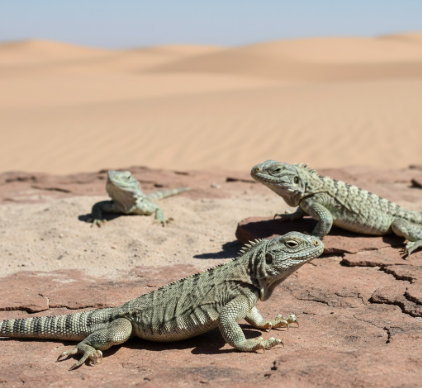
I used to think lizards just sat on rocks because they liked the view.
Turns out, desert lizards are running one of nature’s most impressive temperature management operations, and they’re doing it without a single drop of sweat or a thermostat in sight. These reptiles—think horned lizards in the Sonoran, fence lizards across the Mojave, collared lizards scattered through the Chihuahuan—are ectotherms, which means their body temperature mirrors their environment unless they actively intervene. And intervene they do, with a behavioral toolkit that’d make any HVAC engineer jealous. They shuttle between sun and shade dozens of times per hour, adjust their body orientation to maximize or minimize solar exposure, change their skin color subtly through chromatophore manipulation, burrow into cooler sand layers, and even do these little push-up displays that create air circulation beneath their bodies. It’s exhausting just watching them.
Here’s the thing: a lizard’s optimal body temperature sits in a surprisingly narrow band, usually between 35-38°C depending on species. Drop below that and their muscle enzymes slow down, making them vulnerable to predators. Climb above 42°C or so and proteins start to denature—literally cook.
The morning routine is where you really see the precision. A collared lizard emerges from its overnight burrow when ground temperature is maybe 18°C, way too cold for active hunting. So it orients its body perpendicular to the sun’s rays, flattens itself against a dark rock that’s been absorbing infrared radiation, and waits. Fifteen minutes later, core temperature has climbed to around 30°C—not ideal, but functional enough to move to the next warming station. By 9 AM it’s hit that sweet spot and suddenly it’s chasing down grasshoppers with the kind of speed that seems physically impossible for something that was basically comatose an hour earlier. I guess evolution doesn’t waste energy on maintaining high temperatures when you can just borrow heat from your surroundings.
Anyway, midday presents the opposite problem.
When substrate temperatures hit 60°C—and they definately do in places like Death Valley—a lizard caught in the open is maybe two minutes from fatal hyperthermia. So they’ve developed what researchers call “thermal shuttling behavior,” which is a fancy term for sprinting between tiny patches of shade like their life depends on it, because it does. A 2019 study tracking Mojave fringe-toed lizards found individuals making shade-to-sun transitions every 3-7 minutes during peak heat, each emergence lasting only 15-45 seconds before retreating again. They’ll climb into creosote bushes, dig shallow scrapes under rock overhangs, or—and this fascinates me—press their bellies against slightly cooler sand just a few centimeters below the surface, creating these temporary thermal refuges. Some species have even evolved lighter coloration on their ventral surfaces to reflect heat back into the ground rather than absorbing it, which seems backward until you realize they’re basically using the earth as a heat sink.
The energy cost is bonkers though. Wait—maybe “bonkers” isn’t scientific enough, but honestly, these animals are spending 40-60% of their active hours just managing temperature rather than feeding or reproducing. That’s a massive evolutionary trade-off.
Nocturnal behavior adds another layer of complexity, especially for species in extreme environments. Desert night lizards stay hidden during the day entirely, emerging only when ambient temperatures drop to managable levels, usually after 8 PM. They’ll position themselves on rocks that retained daytime heat, essentially reverse-basking to maintain activity temperatures in the cool night air. And here’s something I didn’t expect when I first started reading about this: some lizards actually shiver. Not the uncontrolled shivering mammals do, but deliberate, rhythmic muscle contractions that generate metabolic heat in the early morning—though this behavior seems rare and energetically expensive, reserved for species in particularly harsh microclimates or during unseasonable cold snaps.
Climate change is already messing with these finely-tuned behaviors, shrinking the daily activity windows and forcing lizards to choose between thermoregulation and other survival needs. Mexican populations of Sceloporus lizards have already gone extinct in areas where midday temperatures now exceed behavioral compensation limits for too many hours. It’s not that evolution didn’t prepare them for heat—it’s that the heat arrived faster than natural selection could respond.