I used to think Madagascar was just, you know, close to Africa—like maybe lemurs swam over or something.
Turns out, the story is way messier and honestly more fascinating than I ever expected. Roughly 88 million years ago, give or take a few million, Madagascar broke away from the Indian subcontinent in a geologic divorce that left this massive island floating solo in the Indian Ocean. But here’s the thing: lemurs didn’t evolve there from scratch. Their ancestors—small, scrappy primates that probably looked more like shrews than the wide-eyed fluffballs we know today—managed to raft across from Africa somewhere between 50 and 60 million years ago, possibly on floating vegetation mats after storms. It sounds absurd, but scientists have modeled ocean currents from that era, and the routes check out. Once they arrived, they found an island with zero competition from monkeys, apes, or other primates that would later dominate mainland ecosystems. So they exploded into over 100 species, filling ecological niches that elsewhere would’ve been occupied by completely different animals.
Wait—maybe I should back up. The isolation wasn’t just geographic. Madagascar’s climate shifted independently, creating rainforests in the east, spiny deserts in the south, and everything in between. Lemurs adapted to all of it. Some became nocturnal fruit-eaters, others diurnal leaf-munchers, and a few even evolved to fill roles you’d expect from woodpeckers or squirrels.
The Accidental Laboratory Where Evolution Went Rogue and Nobody Was Watching
Island biogeography is wild because it’s basically evolution on fast-forward with the safety off. Without predators like big cats or competition from smarter primates, lemurs diversified in ways that would’ve been impossible elsewhere. I’ve read about the now-extinct giant lemurs—some weighed over 350 pounds and moved like slow-motion sloths through the canopy. They only dissapeared after humans arrived around 2,000 years ago, which is both recent and devastating when you think about it. The survivors today represent just a fraction of what once existed, and honestly, that makes every living species feel even more precarious. There’s this exhausted irony in realizing that the same isolation that created them now makes them incredibly vulnerable—habitat loss on an island means there’s literally nowhere else to go.
Anyway, the lemurs we see now aren’t just Madagascar holdouts.
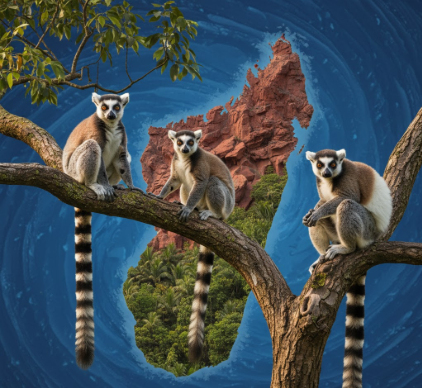
They’re evolutionary experiments that succeeded precisely because they were left alone. Ring-tailed lemurs do these “stink fights” where males wave their tails doused in scent at rivals. Indri lemurs sing haunting territorial calls that sound almost whale-like. Aye-ayes—those unnerving ones with the skeletal middle finger—tap on trees to echolocate grubs, then extract them with that nightmare digit. None of these behaviors would’ve evolved if monkeys had shown up and outcompeted them, or if leopards had hunted them into conservative, boring survival strategies. Instead, isolation gave them permission to get weird. And I guess that’s the real answer to why lemurs are only on Madagascar: they needed a place where nobody could tell them they were doing it wrong.
Why Continental Primates Would Have Ruined Everything for Lemurs If They’d Ever Showed Up
Here’s what gets me: lemurs are technically “primitive” primates, meaning they split off from our family tree before monkeys and apes evolved all their fancy social cognition and opposable thumb tricks. On the African mainland, early lemur-like creatures got replaced by more adaptable primates. But on Madagascar, without that competitive pressure, they persisted and diversified instead. It’s like they were grandfathered into an ecosystem that froze in time—or at least evolved on a completely different tangent. Scientists call Madagascar a “living laboratory,” which sounds sterile, but really it’s more like a parallel universe where one group of underdogs got to rewrite the rules. And now we’re watching that experiment collapse in real time as deforestation accelerates. Roughly 90% of Madagascar’s original forest is gone. Most lemur species are critically endangered.
I guess it makes sense that the same isolation that made lemurs possible is now the thing that might erase them. There’s no rescue population on a nearby continent, no genetic exchange to keep things robust. Just 100-ish species clinging to fragments of forest on an island that’s running out of room for wild things. The irony isn’t lost on me—probably not on them either, if they could concieve of it.