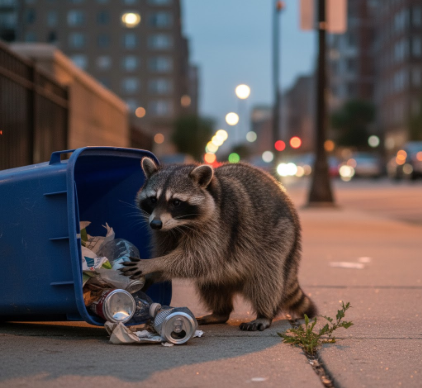
Raccoons weren’t supposed to thrive in cities.
I mean, think about it—these are animals that evolved in forests and wetlands, spending millenia perfecting the art of fishing crayfish from streams and foraging through leaf litter for grubs. Their natural habitat looks nothing like a parking lot or an alley behind a pizza joint. And yet here we are, in 2025, with urban raccoon populations that have exploded to densities sometimes five times higher than their rural counterparts. I used to think this was just about them being opportunistic eaters, but turns out—wait, I’m getting ahead of myself. The thing is, raccoons possess a suite of cognitive and physical adaptations that make them almost preposterously well-suited for city life, even though cities are essentially alien landscapes compared to where they came from. Their success isn’t an accident. It’s the result of specific evolutionary traits colliding with the particular challenges and opportunities that urban environments present, and honestly, the more you look at the details, the more it starts to feel like raccoons were training for this their whole evolutionary history.
The Hyper-Sensitive Hands That Can Open Almost Anything You’ve Got
Raccoon paws are genuinely weird. Each front paw has roughly 25,000 mechanoreceptor cells concentrated in the fingertips—that’s about four times the density humans have. These aren’t just generic touch sensors either; they’re specialized receptors called Pacinian corpuscles that detect vibrations and textures with absurd precision. When a raccoon dunks its food in water (that whole “washing” behavior everyone knows), it’s not actually cleaning anything—it’s softening the skin on its paws to enhance tactile sensitivity even further.
Here’s the thing: this adaptation, which evolved for finding hidden prey under rocks and in murky water, turns out to be perfect for urban problem-solving. Raccoons can manipulate complex mechanisms—twist-off caps, lever-action garbage can lids, even door handles—because their paws can both sense and execute intricate movements. I’ve seen footage of raccoons solving puzzle boxes that stumped some primate species. They don’t just use brute force; they probe, test, remember, and adapt their approach.
And they learn fast. Disturbingly fast.
Brain Plasticity and the Neural Architecture of Mischief
Suzana Herculano-Houzel’s lab at Vanderbilt did something kind of brilliant a few years back—they actually counted neurons in raccoon brains. Not estimated. Counted. And what they found was that raccoons pack neuron densities in their cerebral cortex comparable to primates. For their body size, raccoons have more cortical neurons than cats, and their neuron-to-brain-mass ratio rivals some monkey species. This matters because cortical neurons are strongly correlated with problem-solving ability and behavioral flexibility.
But wait—maybe the even more interesting part is how raccoons use those neurons. Studies tracking urban raccoons in Toronto (which has basically become Raccoon Research Central at this point) show these animals developing novel foraging strategies within a single generation. One population figured out how to open a specific type of compost bin; within eighteen months, roughly 80% of the local raccoons had learned the technique, even individuals who’d never encountered that bin type before. That’s cultural transmission of learned behavior, which is vanishingly rare in non-primate mammals.
I guess it makes sense. In the wild, raccoons need to adapt their foraging to seasonal changes and unpredictable food sources. Cities just crank that variability up to eleven. Every neighborhood is different, every garbage system has its own quirks, and food sources appear and disappear constantly. The raccoons that succeed are the ones who can learn, remember, and—this is key—teach.
Omnivorous Opportunism Meets the Human Waste Stream
Raccoons will eat basically anything. Their digestive system handles an absurdly broad range of foods—from fruit and nuts to insects, amphibians, bird eggs, small mammals, and yes, definately your leftover pad thai. This dietary flexibility, which evolved as a hedge against seasonal scarcity, becomes a superpower in urban environments where the human waste stream provides a year-round buffet of high-calorie options.
The caloric density matters more than you’d think. Wild raccoons spend huge amounts of energy foraging for scattered, low-reward food items. Urban raccoons, accessing concentrated human food waste, can meet their daily caloric needs in a fraction of the time. This frees up hours for other activities—primarily sleeping, reproducing, and learning new ways to defeat whatever garbage can innovation humans have invented this week. A study in Chicago found urban raccoons spend about 40% less time foraging than rural ones, despite having access to significantly more food.
And here’s where it gets messy: that extra food doesn’t just mean more raccoons. It means healthier raccoons, reproducing earlier and more frequently. A well-fed urban female might have her first litter at 10 months instead of the typical 2 years, and produce larger litters—sometimes 6 or 7 kits instead of the rural average of 3-4. Over just a few generations, this creates population dynamics that would be unsustainable in natural habitats.
Honestly, we created this situation. Cities offer raccoons everything they need: abundant food, plenty of denning sites (attics, crawl spaces, storm drains), fewer natural predators, and a complex environment that rewards intelligence. They’re not invading our space—we built them a habitat specifically optimized for their skill set, then acted surprised when they moved in.
The thing that keeps me up at night, though? We keep making cities bigger.