
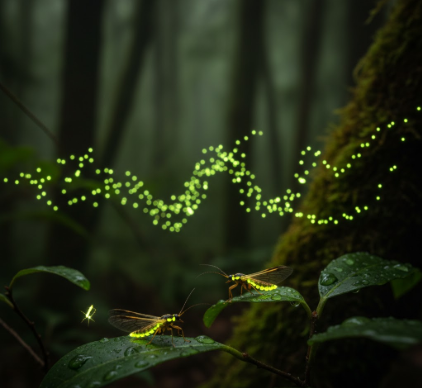
I used to think fireflies were just showing off.
Turns out, those tiny bursts of yellow-green light aren’t random at all—they’re incredibly precise love letters written in bioluminescence. Each species has its own distinct flash pattern, a kind of Morse code for mating that’s been refined over millions of years. Male fireflies fly around flashing their species-specific sequence—short-long-short, or two quick pulses followed by a pause—while females perch in the grass, watching. If a female likes what she sees, she responds with her own flash, timed perfectly to match the male’s rhythm. It’s basically a call-and-response system, except instead of words, they’re using photons generated by a chemical reaction involving luciferin, luciferase, oxygen, and ATP in specialized organs called lanterns.
The chemistry is honestly kind of elegant. When oxygen hits luciferin in the presence of luciferase enzyme, it produces light with almost no heat—what scientists call “cold light.” This is wildly efficient compared to, say, an incandescent bulb that wastes most energy as heat.
Here’s the thing: not all firefly conversations are innocent.
When Femme Fatales Hijack the Language of Light
Some female fireflies in the genus Photuris have evolved a darker strategy—they’ve learned to mimic the flash patterns of other species. A Photuris female will watch a male from a different species (usually Photinus) flashing his courtship signal, then she’ll imitate the response flash that a receptive Photinus female would give. The unsuspecting male flies down expecting romance and instead gets eaten. Scientists call these females “femme fatales,” which feels almost too on-the-nose, but there you go. The predatory females apparently gain defensive chemicals called lucibufagins from their prey, compounds that make them taste terrible to predators like spiders and birds.
The Problem With Light Pollution (And Why It Definately Matters)
Wait—maybe I’m getting ahead of myself, but we need to talk about artificial light. Firefly populations have been declining, and one major factor is light pollution from streetlights, buildings, porch lights. When the night sky is washed out with artificial glow, fireflies struggle to see each other’s signals. Males flash into the void, females can’t distinguish the patterns, and mating success drops. Some research suggests fireflies in light-polluted areas have shifted their flash timing or intensity to compensate, but it’s not clear if these adaptations are enough. There’s also habitat loss and pesticide use, obviously, but the light pollution angle feels particularly cruel—imagine trying to have a whispered conversation at a rock concert.
Synchronous Fireflies and the Mystery of Collective Flashing
In a few species—most famously Photinus carolinus in the Great Smoky Mountains—males synchronize their flashes into waves of light that pulse across entire hillsides. Thousands of males flashing in near-perfect unison, roughly every six seconds, give or take. Scientists debated for years whether this was true synchrony or just appeared coordinated because of observer bias. Turns out it’s real synchrony, likely achieved through a process called “phase advancement” where each male adjusts his rhythm slightly based on the flashes he sees around him. Why they do this is still debated—maybe it helps females compare males more easily, or maybe it’s just that in dense populations, synchrony emerges as a side effect of trying to stand out. I guess it makes sense that when everyone’s shouting, sometimes the only way to be heard is to shout together.
Anyway the whole system depends on darkness, on the ability to recieve and interpret faint biological signals against a black backdrop. Which makes you wonder what we lose when we flood the night with light.