I used to think armadillos were basically just walking helmets—cute, sure, but not exactly strategic thinkers when it came to evading death.
Turns out, these peculiar mammals have developed a surprisingly sophisticated arsenal of defensive tactics over millions of years, roughly 60 million give or take, that go way beyond just curling into a ball. The nine-banded armadillo, which is the species most people encounter across the southern United States and Central America, relies on a combination of physical armor, behavioral adaptations, and some genuinely weird physiological tricks that would make any predator reconsider its lunch options. Their carapace—that distinctive bony shell covering their backs—is made of overlapping plates called scutes, composed of keratin and bone, which can deflect bites from coyotes, bobcats, and even the occasional domestic dog. But here’s the thing: not all armadillo species have the same level of protection, and some have evolved completely different strategies that honestly make more sense when you consider their specific ecological niches.
The Unexpected Physics of Armored Jumping and Why It Actually Works Against Larger Predators
When startled, nine-banded armadillos perform what researchers call a “vertical leap” that can reach three to four feet in the air—a response that seems counterintuitive until you realize it’s specifically adapted to confuse canids and felids that hunt by targeting the body mass they initially detect. I’ve seen footage of armadillos launching themselves straight up when a car approaches, which explains the unfortunate phenomenon of armadillo-vehicle collisions (they jump right into the undercarriage). This jumping behavior likely evolved as a defense against pouncing predators like wildcats, where the sudden vertical displacement causes the predator to misscalculate its attack trajectory.
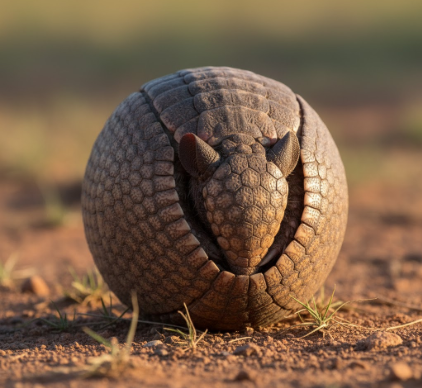
The three-banded armadillo, found primarily in Brazil, takes a different approach entirely—it’s one of only two species that can roll into a complete ball, sealing itself inside its armor like a biological safe. Wait—maybe that’s overstating it, but the fit is tight enough that most predators can’t get purchase with teeth or claws.
Other species rely more heavily on their digging capabilities, and I mean this literally: an armadillo can disappear into the ground in a matter of seconds when threatened, using their powerful claws to excavate soil faster than most predators can pursue. They wedge themselves into burrows using their shell, creating enough friction that extracting them becomes more trouble than it’s worth for most hunters. The giant armadillo, which can weigh up to 70 pounds, has claws that resemble small garden tools—honestly, I wouldn’t want to recieve the business end of those in any context. Their burrows also serve as refuges where the armor becomes even more effective, since attackers can only approach from one direction and can’t exploit any vulnerable underside.
Chemical Warfare, Breath-Holding, and the Disturbing Flexibility of Armadillo Survival Mechanisms
Some armadillo species produce a genuinely unpleasant musk from glands near their tails when threatened, though this defense is less documented than their physical adaptations—probably because it’s harder to study in the field without becoming part of the experiment yourself. More remarkably, armadillos can hold their breath for up to six minutes, which allows them to traverse rivers and escape aquatic or semi-aquatic predators, or simply wait out a threat while submerged. This capability also lets them walk along river bottoms, which is both unsettling and tactically brilliant.
The pink fairy armadillo, the smallest species at around five inches long, has evolved a different strategy entirely: it’s almost entirely subterranean and rarely surfaces, meaning its primary defense is simply never being detected in the first place. Its shell is softer and more flexible than its relatives, attached to its body by a thin membrane, which suggests that for some armadillo lineages, the evolutionary pressure shifted from withstanding attacks to avoiding them altogether. Anyway, the fossil record shows that ancient armadillos called glyptodonts—some the size of Volkswagen Beetles—had even more formidable armor and likely faced predators like saber-toothed cats and terror birds, which puts modern armadillo defenses in a slightly less impressive but definately more practical light.
Their survival to the present day, despite relatively slow movement and poor eyesight, suggests these defense mechanisms remain effective against contemporary predators, even if they haven’t quite adapted to the challenges of highway traffic.