I used to think giraffes were just, you know, tall horses with spots.
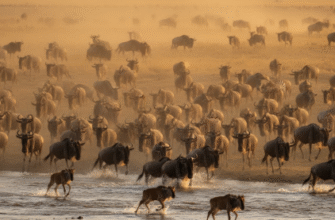
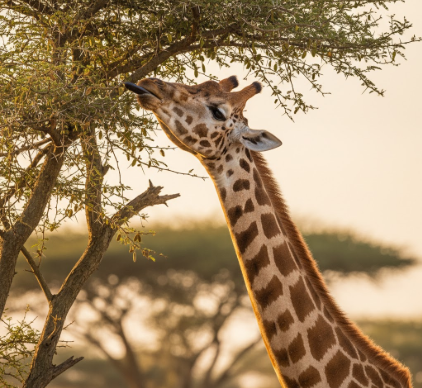
But here’s the thing—when you actually watch a giraffe feed in the Serengeti, something clicks. I spent three weeks in Tanzania a few years back, mostly photographing wildebeest migrations, and one afternoon I just sat there watching a male giraffe strip leaves from an acacia tree about eighteen feet off the ground. The precision was unsettling, almost mechanical: that long tongue wrapping around branches, the head tilting at angles that would snap a human neck, the whole body swaying like some kind of biological crane. No other herbivore in that ecosystem could reach those leaves. Not the elephants, not the kudus, definitely not the gazelles nervously grazing below. The giraffe had an entire vertical buffet to itself, and it seemed—I don’t know—almost bored by the abundance.
Turn out, that neck isn’t just long for the hell of it. It’s roughly six feet of vertebrae, same number as ours (seven), just stretched into something that looks like evolutionary overconfidence. Each vertebra can be ten inches long, stacked with insane precision and cushioned by cartilage that would make an orthopedic surgeon weep with envy.
Wait—maybe I should back up.
The feeding advantage theory goes back to Charles Darwin, though he was actually pretty vague about it in On the Origin of Species. Jean-Baptiste Lamarck got there first, sort of, suggesting that giraffes stretched their necks over generations by reaching for high foliage—which is wrong, obviously, but at least he was thinking about the problem. The modern understanding is more brutal: giraffes with longer necks could access food sources during droughts when lower vegetation dried up or got obliterated by competition. Over thousands of generations, maybe 500k years give or take, the short-necked individuals just… lost. They starved, didn’t reproduce as successfully, and their genes faded from the population. Natural selection doing its slow, indifferent work.
Anyway, the data backs this up.
Why vertical browsing fundamentally changed the evolutionary game for giraffes in African savannas
A 2015 study in the Journal of Mammalogy tracked feeding patterns of Masai giraffes across different seasons. During the wet season, giraffes fed at all heights, sometimes even bending down to graze like common antelopes—which looked ridiculous, honestly, like watching a construction crane try to pick up a penny. But during dry months, when ground-level plants withered, the giraffes spent 94% of their feeding time above thirteen feet. The researchers also noted that male giraffes, which are taller than females, fed even higher, sometimes reaching twenty feet into the canopy. This created a kind of vertical segregation: males dominated the highest branches, females took the middle tier, and younger giraffes made do with whatever they could reach below ten feet.
The competitive edge is staggering when you map it out. Acacia trees, which dominate much of giraffe habitat, have evolved their own defenses—thorns up to three inches long, toxic tannins in the leaves—but giraffes have counter-evolved thick saliva and a leathery tongue that can extend eighteen inches. I’ve seen footage of a giraffe tongue just shrugging off thorns that would puncture a car tire. The feeding process looks almost violent: grab, strip, chew, repeat, with this weird methodical patience.
But here’s where it gets messy.
Some biologists argue the neck isn’t primarily about feeding at all. A 2016 paper by Rob Simmons and Lue Scheepers suggested that sexual selection drove neck elongation—males use their necks as weapons, swinging their heads like wrecking balls during fights called “necking.” The longer and heavier your neck, the harder you can hit, and the more likely you are to win mating rights. Female giraffes apparently prefer males who win these brutal contests, so neck length becomes a secondary sexual characteristic, like a peacock’s tail or a lion’s mane. The feeding advantage, in this view, is just a convenient side effect.
The biomechanical nightmare of pumping blood up a six-foot neck and why it actually works
Honestly, I go back and forth on this. Both theories have merit, and they’re not mutually exclusive—evolution rarely optimizes for just one thing. A long neck can be both a feeding tool and a weapon, just like human hands are both for tool use and punching.
What’s not debatable is the cardiovascular insanity required to make this work. A giraffe’s heart weighs about 25 pounds and generates blood pressure roughly twice that of a human—280/180 mmHg compared to our 120/80. Without that pressure, blood wouldn’t reach the brain when the head is elevated. But then when a giraffe bends down to drink, that same pressure would cause a catastrophic stroke. So they’ve evolved a complex system of valves, elastic blood vessels, and a spongy structure at the base of the brain called the rete mirabile (“wonderful net”) that regulates flow. It’s biological engineering on a scale that makes human attempts at hydraulics look primitive.
The energy cost is brutal too. Just maintaining that blood pressure requires an estimated 10% more caloric intake than a similar-sized animal with a normal neck. But the payoff—exclusive access to food reserves that sustain you through droughts when everything else is starving—apparently made it worth it. Evolution doesn’t care about elegance; it cares about reproduction, and if a ridiculously long neck gets your genes into the next generation, then ridiculous wins.
I guess what strikes me most is how contingent it all feels. If African climates hadn’t cycled through those prolonged dry periods, if acacia trees hadn’t been so abundant, if some other herbivore had evolved a different solution to the same problem—maybe we’d live in a world without giraffes, or with giraffes that look completely different. Instead we got this weird, towering result of millions of years of trial and error, standing there chewing leaves with an expression that somehow manages to be both graceful and vaguely confused.
They’re still here, anyway, which counts for something.