I used to think sea turtles were just stubborn.
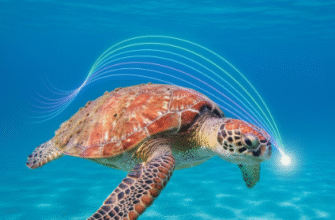
Like, imagine swimming thousands of miles across an entire ocean, dodging sharks and fishing nets and plastic bags that look way too much like jellyfish, only to haul yourself onto the exact same beach where you hatched decades ago. It sounds exhausting, honestly. But here’s the thing—these ancient mariners aren’t being sentimental or nostalgic. They’re following a magnetic map imprinted in their brains before they ever saw sunlight, a navigational system so precise it makes our GPS look like a child’s drawing. Scientists have spent roughly 40 years, give or take, trying to crack this code, and what they’ve found is equal parts beautiful and slightly unnerving: baby turtles, fresh out of their eggs, somehow record the magnetic signature of their birth beach during those first frantic hours of life. That signature becomes their homing beacon for the rest of their existence.
The Magnetic Imprinting Hypothesis That Actually Holds Water
Turns out the Earth’s magnetic field isn’t uniform—it varies by location, creating unique combinations of intensity and inclination angle. Kenneth Lohmann at UNC Chapel Hill figured this out by putting hatchling loggerheads in water tanks surrounded by magnetic coils. When he tweaked the fields to match different locations along the Atlantic coast, the baby turtles swam in directions that would’ve taken them to age-appropriate feeding grounds. Wait—maybe that’s not the wildest part. The wildest part is they were doing calculus with magnetic fields before their eyes fully opened.
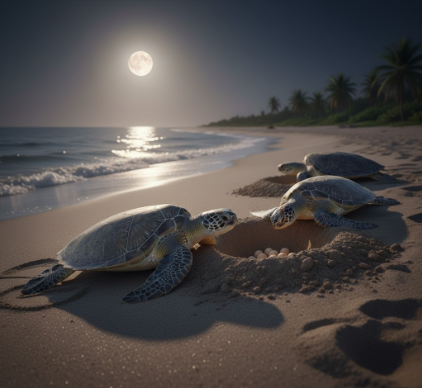
This imprinting happens during what researchers call the “crawl”—that desperate dash from nest to ocean that kills about 60% of hatchlings before they even touch water. The survivors are apparently multi-tasking, recording geomagnetic data while also trying not to become bird food. I’ve seen footage of this and it never stops being stressful to watch.
Why Evolution Decided Natal Homing Was Worth the Ridiculous Effort
So why bother returning at all? Beaches aren’t interchangeable real estate. A beach that successfully incubated your egg 30 years ago has already proven it has the right sand temperature, grain size, vegetation cover, and predator levels to produce viable offspring. It’s evolutionary logic—if it worked once, bet on it again. Female leatherbacks will swim from Indonesian feeding grounds to the same 200-meter stretch of Malaysian coastline where they hatched, ignoring thousands of miles of perfectly acceptable beach. That’s not sentimentality; that’s data-driven reproductive strategy.
Honestly, the philopatry is almost absurdly precise.
Genetic studies of green turtle populations show that females return not just to the same beach, but often to within a few hundred meters of their natal site. This creates these weird genetic subdivisions—turtles nesting on beaches just 50 kilometers apart can be more genetically distinct than populations separated by entire ocean basins. It’s like evolution ran an experiment in extreme site fidelity and then couldn’t turn it off. Some researchers think this also helps maintain local adaptations—like temperature tolerance or nest depth preferences—that wouldn’t spread if turtles just nested anywhere convenient. But it also means that if you lose a nesting beach to development or sea-level rise, you’re not just losing sand; you’re erasing an entire matrilineal lineage that’s been returning there for potentially thousands of generations.
The Terrifying Vulnerability of a System That Depends on Beaches Not Moving
Which brings us to the uncomfortable present. Magnetic navigation only works if the destination still exists when you arrive. Climate change is redistributing sand, altering beach profiles, and in some cases just swallowing coastlines entirely. There’s this heartbreaking thing happening in Florida where turtles return to their natal beaches and find seawalls or hotels instead of dunes. They’ll circle offshore for hours, confused, before either nesting in terrible locations or just giving up. I guess the system that worked for 100 million years didn’t account for us rearranging the coastline in a single human lifetime.
And the magnetic fields themselves are shifting—not much, but enough that the maps these animals carry might become outdated within a few generations. Some populations are showing slight flexibility, nesting on nearby beaches when their primary site becomes unusable, but it’s unclear if that adaptability can scale fast enough. The turtles are still following the rules. We’re the ones who changed the game.