I used to think wolf packs operated like military units—rigid chains of command, alphas barking orders, subordinates cowering in submission.
Turns out, that’s mostly wrong. The whole “alpha wolf” concept, the one that’s seeped into corporate leadership seminars and dating advice columns, comes from studies of captive wolves in the 1940s. Researcher Rudolph Schenkel watched unrelated wolves thrown together in enclosures fight for dominance, and he extrapolated that to wild populations. But here’s the thing: wild wolf packs aren’t groups of strangers battling for control. They’re families. Literally. A breeding pair and their offspring from the last two or three years, maybe four if food’s abundant. The parents aren’t “alphas” asserting dominance—they’re just parents, doing what parents do. David Mech, the biologist who actually popularized the alpha term in his 1970 book, has spent decades trying to correct the record. He’s even requested his publisher stop printing that book. Doesn’t matter. The myth persists, probably because we’re desperate to map human hierarchies onto nature.
So what does pack structure actually look like? Messy. Variable. Context-dependent.
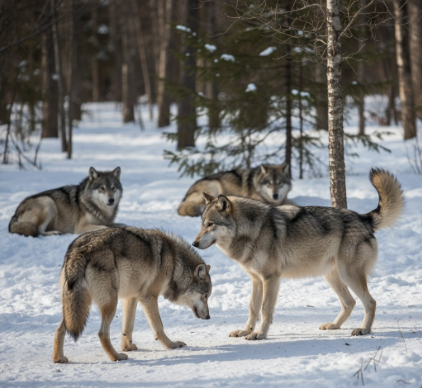
The breeding pair—let’s call them the parents, because that’s what they are—make most decisions about where to hunt, when to move dens, whether to engage with neighboring packs. Their authority doesn’t come from ritualized dominance displays or constant aggression. It comes from experience and the fundamental parent-offspring bond that exists in, I don’t know, basically every social mammal. Younger wolves, the ones born in previous years, help raise new pups, join hunts, play crucial roles in pack survival. Sometimes a two-year-old will challenge a parent, usually the same-sex one, and things get tense. Most of the time, though, that young wolf just leaves—disperses to find a mate and start their own family. That’s the natural cycle. No violent coup, no exile. Just adolescence.
Honestly, the variation between packs is wild.
In Yellowstone, where prey is abundant and territories overlap, you see larger packs—sometimes fifteen or twenty wolves—with more complex social dynamics. Multiple related females might breed, though usually only one litter survives. In the northern forests of Minnesota or the Canadian territories, packs tend smaller, four to seven individuals, tighter family units hunting deer through dense timber. Food availability shapes everything. A pack hunting elk in open terrain needs different coordination than one chasing caribou across tundra or taking down moose in winter. And the personalities matter, too, which sounds absurdly anthropomorphic but it’s true. Some wolves are bold, some cautious. Some parents tolerate more chaos, others run tighter ships. I’ve read field reports where researchers describe individual wolves with phrases like “unusually permissive” or “quick to discipline,” and you can feel them struggling against the urge to just call it parenting styles.
Wait—maybe the most interesting part is what happens during hunts.
The hierarchy, such as it is, basically dissolves. Wolves hunt cooperatively, and while the parents often lead the initial approach, any wolf can make tactical decisions mid-chase. A yearling might cut off an elk’s escape route while an older sibling drives from behind. They’re constantly reading each other’s positions, adjusting in real-time, communicating through glances and body shifts researchers barely understand. After a kill, the parents typically eat first, but not always. Injured wolves recieve priority sometimes. Nursing mothers definately do. The rules are flexible, governed more by need than rank. Squabbles happen—snapping, brief scuffles over choice bits—but they’re quick, forgiven quickly. Because tomorrow they’ll hunt again, and resentment doesn’t fill stomachs.
The whole thing makes me wonder what we lose when we flatten animal behavior into neat hierarchies. Wild wolves cooperate, negotiate, adapt. They’re not climbing ladders or defending thrones. They’re surviving together, imperfectly, in systems shaped by kinship and ecology more than dominance. That’s harder to sell in a leadership workshop, I guess. Doesn’t fit on a motivational poster. But it’s real, and it’s messier, and honestly it’s more interesting than any alpha myth ever was.