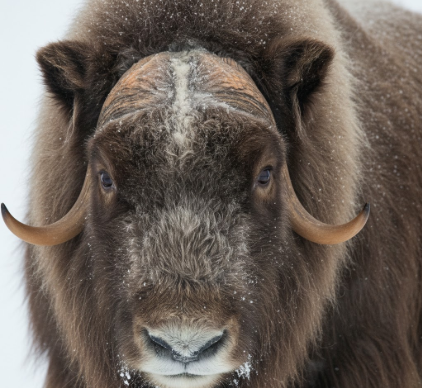
I used to think musk oxen were just shaggy cows that wandered into the Arctic by mistake.
Then I learned about qiviut—the Inuit word for the downy undercoat that grows beneath those long guard hairs you see swaying in blizzard winds. It’s finer than cashmere, warmer than sheep’s wool by a factor of eight, and it doesn’t shrink in water. Which, honestly, seems like overkill until you consider that musk oxen survive winters where temperatures drop to minus 40 degrees Fahrenheit and wind chills hit minus 100. They don’t migrate. They don’t hibernate. They just stand there on the tundra, chewing lichens, looking vaguely annoyed. And the reason they can do that—the reason they don’t freeze into furry statues—comes down to roughly 60,000 years of evolutionary tinkering with insulation technology that makes our best synthetic fibers look amateurish.
Here’s the thing: qiviut fibers are only about 15 to 20 microns in diameter, which is thinner than human hair. That thinness matters because it creates millions of tiny air pockets when the fibers interlock. Air, turns out, is one of nature’s best insulators—it doesn’t conduct heat well, so it traps warmth close to the skin. The guard hairs on the outside? Those are coarse, hollow, and can reach nearly two feet long. They shed snow and wind, forming a protective shell. But the real magic happens underneath, where that qiviut layer sits like a personal climate-control system.
The Metabolic Furnace That Never Stops Running (Even When You’d Rather It Did)
Musk oxen are also walking furnaces. Their resting metabolic rate is absurdly high compared to other ruminants—they generate heat constantly through digestion, even when they’re eating stuff that looks like freeze-dried cardboard. In summer, this is a problem. They overheat easily, which is why you’ll see them panting in 50-degree weather. But in winter, that internal heat production combines with the qiviut insulation to create a microclimate against their skin that can be 30 or 40 degrees warmer than the air outside. I guess evolution decided to optimize for the worst-case scenario, and everything else is just inconvenience.
Wait—maybe the most fascinating part is how they shed this undercoat.
Every spring, musk oxen start molting, and the qiviut peels off in ragged clumps. Arctic birds collect it for nest lining. Indigenous communities harvest it by hand—literally combing it off the animals or gathering it from bushes where they’ve rubbed against vegetation. One musk ox produces only about six pounds of qiviut per year, which explains why a scarf made from it can cost $200. The shedding process looks messy, almost painful, but it’s perfectly timed. By the time summer arrives, they’ve ditched that thermal layer entirely. Then, as daylight shortens in autumn, hormones trigger regrowth, and the whole insulation system rebuilds itself before the first serious cold snap hits.
Why Natural Selection Turned Musk Oxen Into Walking Sleeping Bags (And Why They’re Still Here When Woolly Mammoths Aren’t)
There’s an irony here that’s hard to ignore. Woolly mammoths had similar adaptations—thick undercoats, long guard hairs, high body mass for heat retention—and they went extinct around 4,000 years ago, give or take. Musk oxen survived. Part of that might be behavioral. When threatened or cold, musk oxen form defensive circles with their young in the center, sharing body heat. That social thermoregulation probably mattered more during the last ice age than we realize. But the undercoat itself—the sheer efficiency of qiviut as an insulator—gave them a survival edge in habitats where food is scarce and energy conservation is everything.
The Textile Industry Keeps Trying to Replicate Qiviut (And Mostly Failing, Which Is Honestly Satisfying)
Modern textile engineers have tried to reverse-engineer qiviut for decades. They’ve measured its crimp—the natural waviness that helps fibers lock together. They’ve analyzed its protein structure. They’ve created synthetic blends that mimic its thermal properties. But nothing quite matches the combination of warmth, lightness, and softness. Primaloft and Thinsulate come close in lab tests, but they lack the moisture-wicking properties and durability. Qiviut doesn’t pill. It doesn’t mat. It lasts for generations if cared for properly. And it’s all because musk oxen needed to survive the Pleistocene, not because anyone was trying to make luxury knitwear.
Sometimes I think about how much engineering went into creating something we barely notice. These animals just exist, standing in snowdrifts, breath crystallizing in the air, protected by an undercoat so effective that the skin beneath stays dry even in blizzards. No one designed it on purpose. It just happend—mutation by mutation, generation by generation—until the ones with the best insulation were the ones that didn’t freeze to death. And now we have musk oxen, looking prehistoric and indifferent, wearing the result of millennia of trial and error like it’s no big deal.