I used to think sea turtles just kind of drifted around the ocean until they randomly bumped into food.
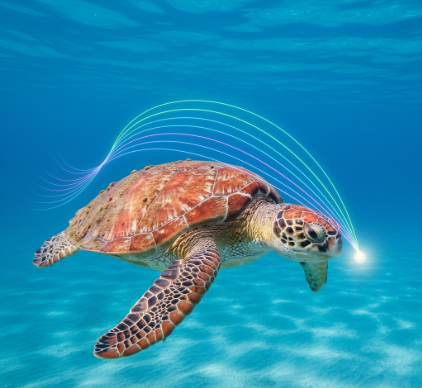
Turns out, loggerhead sea turtles are navigating with a precision that would make a GPS engineer weep with envy—and they’re doing it with magnetism. These ancient mariners, which have been crossing ocean basins for something like 100 million years (give or take a few million), possess what researchers call a ‘magnetic map’ embedded somewhere in their biology. When a baby loggerhead the size of your palm crawls into the Atlantic for the first time, it’s already equipped with the ability to read Earth’s magnetic field like you might read street signs, detecting both the intensity and the angle of magnetic lines to figure out exactly where it is. The mechanism isn’t fully understood—honestly, we’re still picking apart the details—but scientists have identified magnetite crystals in turtle brains that might act as tiny compass needles, and there’s also evidence that light-sensitive proteins in their eyes could be involved in a quantum-level magnetic sensing process that sounds like science fiction but definately isn’t.
Wait—maybe the most stunning part is the imprinting. Kenneth Lohmann at the University of North Carolina has spent decades demonstrating that hatchling loggerheads memorize the magnetic signature of their birth beach. When they’re ready to nest, sometimes 20 or 30 years later, they use that magnetic memory to navigate back across thousands of miles of open ocean to the same stretch of coastline where they hatched.
Here’s the thing: the magnetic field isn’t static, and loggerheads know it. Earth’s magnetic field shifts gradually over time—the north magnetic pole wanders, field intensity fluctuates—and there’s mounting evidence these turtles update their internal maps throughout their lives. In laboratory experiments, researchers exposed young turtles to magnetic fields mimicking different locations along their migration route: the northern Atlantic near Virginia, the mid-Atlantic, the southern gyre near Brazil. The turtles oriented themselves in the direction they would naturally swim if they were actually in those locations, proving they weren’t just following a simple compass heading but were genuinely reading a complex magnetic landscape.
The Underwater Highway System That Exists in Invisible Lines of Force
The North Atlantic gyre—a massive circular current system—is basically a loggerhead superhighway, and magnetic cues are the lane markers. Juvenile loggerheads ride this current loop for years, sometimes a decade, growing from hatchlings into dinner-plate-sized adolescents.
Along this route, they encounter distinct magnetic regions, each with a unique combination of field intensity and inclination angle. Researchers mapped these magnetic signatures and then tested whether turtles could distinguish between them in controlled settings, and yeah, they could. A turtle exposed to the magnetic field characteristic of the southern part of the gyre would swim northeast; expose it to a northern signature, and it would head south. It’s like they’re constantly triangulating their position, adjusting their heading based on magnetic coordinates that exist independent of any visible landmarks—which is good, because there aren’t any landmarks in the middle of the ocean.
Magnetite Crystals, Cryptochromes, and the Biological Compass We’re Still Trying to Understand
I guess it makes sense that we haven’t totally cracked the mechanism yet.
The leading hypotheses involve two different systems. First, there’s magnetite-based magnetoreception: tiny crystals of magnetite (Fe₃O₄), which is naturally magnetic, have been found in the brains of loggerheads and other migratory animals, positioned near nerve clusters that could theoretically transmit directional information. Think of these crystals as microscopic compass needles that physically rotate in response to Earth’s magnetic field, potentially triggering mechanosensitive ion channels in adjacent neurons. Second—and this is where things get weird—there’s the cryptochrome hypothesis. Cryptochromes are proteins in the retina that are sensitive to blue light, and when they absorb photons, they form radical pairs: molecules with unpaired electrons whose quantum spin states are influenced by magnetic fields, producing chemical signals that might allow turtles to literally see magnetic fields as patterns of light and dark overlaid on their visual field.
Both mechanisms might be working together, honestly, though the research is still messy and incomplete.
When Magnetic Maps Fail Because Humans Changed the Scenery
Anyway, here’s where conservation gets urgent. Artificial magnetic fields from undersea cables, offshore energy infrastructure, and even coastal development are creating magnetic noise that could interfere with turtle navigation. There’s also evidence that climate change is shifting ocean currents, which means the routes loggerheads have been swimming for millennia might no longer align with food availability or suitable nesting beaches. A few studies have documented disoriented hatchlings in areas with high electromagnetic activity, though the long-term population effects aren’t clear yet.
And light pollution is another problem—artificial lights on beaches draw hatchlings inland instead of seaward, but some researchers wonder if intense artificial lighting might also disrupt cryptochrome-based magnetic sensing if that system depends on natural light conditions. It’s speculative, but worth investigating given how many turtle nesting beaches are now flanked by hotels and condos with lights blazing all night. We’re essentially running an uncontrolled experiment on a navigation system that took 100 million years to evolve, and we won’t know the results until populations start declining—or maybe they already are, and we’re just not connecting the dots yet.
The Hatchling That Knows More About Planetary Geophysics Than Most Humans
There’s something humbling about a two-ounce turtle possessing sensory abilities we can barely replicate with sophisticated instruments. When you watch a loggerhead hatchling disappear into the surf—and I’ve seen this a few times on research trips, always at night, always chaotic with volunteers trying to keep track of dozens of tiny shapes scrambling toward the waves—you’re watching an animal that will navigate across an entire ocean basin using a sense you don’t have, reading a map you can’t see, on a journey that will take decades and cover thousands of miles before it comes full circle.
Honestly, we’re still figuring out the basics.