I used to think dolphins were just smart mammals doing flips for tourists.
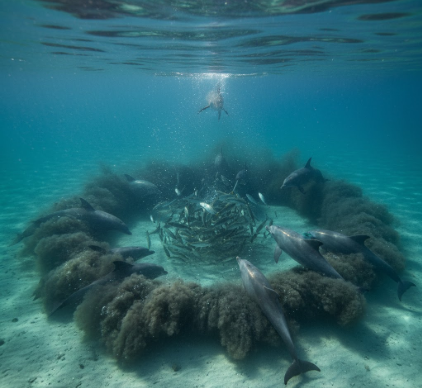
Then I watched footage from Florida Bay—grainy, handheld stuff from a research boat—where a bottlenose dolphin swam in a tight circle near the muddy bottom, thrashing its tail flukes hard enough to kick up sediment that hung in the water like a curtain. Within seconds, other dolphins appeared, positioning themselves around this murky ring while fish trapped inside panicked and leaped straight into waiting jaws. The whole thing lasted maybe thirty seconds, but I kept rewinding it because here’s the thing: this wasn’t just hunting. This was architecture, coordination, timing—like watching a construction crew that also happened to eat their building materials.
Scientists call it “mud ring feeding,” and it’s been documented primarily in the shallow waters off Florida’s Gulf Coast, though similar behaviors pop up in other coastal regions where the bottom sediment cooperates. The technique requires at least two dolphins, sometimes more, working in what can only be described as assigned roles.
The Physics of Trapping Fish With Silt and Cooperation
One dolphin—let’s call it the “ring maker”—swims in a circle roughly ten to fifteen feet in diameter, angling its body to drive the tail flukes into soft substrate. The mud plume rises and spreads outward, creating a temporary barrier that fish instinctively avoid crossing because, turns out, most prey species hate reduced visibility even more than predators do. Meanwhile, the other dolphins station themselves outside this ring, spacing themselves evenly like points on a compass. They wait—and this is where it gets weird—because the fish don’t try to swim through the mud. Instead, they panic upward, breaching the surface in chaotic arcs, and that’s when the waiting dolphins lunge vertically, mouths open, sometimes clearing the water entirely. I guess it makes sense from an energy perspective: why chase prey horizontally through open water when you can engineer a situation where they literally throw themselves at you?
The timing has to be near-perfect. Too slow, and the mud settles before the trap closes. Too fast, and fish scatter before the ring completes.
Researchers from the Dolphin Communication Project and Florida Atlantic University have spent years documenting this behavior, using drone footage and acoustic monitoring to understand how dolphins coordinate without obvious signals—no clicks, no whistles that we can definitley detect as “commands.” Some scientists hypothesize they’re reading each other’s body language and positioning with a precision that suggests years of practice, possibly learned from older pod members. Honestly, we’re still figuring out how much is instinct versus taught skill. Calves have been observed watching from a distance, not participating but clearly paying attention, which suggests this might be transmitted culturally rather than genetically encoded. Wait—maybe both? The data’s still messy on that front.
Why This Matters Beyond Just Being Cool Footage for Nature Documentaries
Cooperative hunting isn’t rare in the animal kingdom—wolves do it, orcas do it, even some spiders coordinate in groups—but the mud ring technique represents something closer to tool use, where the environment itself becomes part of the strategy. The dolphins aren’t modifying a physical object like sea otters with rocks, but they’re manipulating the medium they move through to create a functional structure that wouldn’t exist otherwise. That’s cognitively expensive behavior, requiring spatial reasoning, predictive modeling of how sediment disperses in current, and trust that your partners won’t just steal your catch mid-leap.
And here’s where it gets slightly frustrating: we don’t actually know how long dolphins have been doing this. Anecdotal reports from fishermen in the region go back decades, maybe longer, but systematic study only started in the 1990s. For all we know, this could be a relatively recent innovation—some dolphin equivalent of a culinary trend—or it could be ancient, passed down through hundreds of generations. The fossil record won’t help us here; mud rings don’t fossilize, and behavioral evolution leaves no bones.
What we do know is that not all bottlenose populations use this technique, even in areas with suitable substrate. Some Florida Bay pods do it regularly; others, living just miles away in similar conditions, never attempt it. That geographic patchiness strongly suggests learned behavior rather than hardwired instinct, which raises uncomfortable questions about what else dolphins might be capable of inventing that we simply haven’t witnessed yet because we weren’t pointing cameras at the right patch of ocean at the right time.
I’ve seen researchers describe their work with a mix of excitement and exhaustion—the kind that comes from studying animals smart enough to have regional dialects and individual personalities but who live in an environment we can only visit temporarily, where most of their lives happen beyond our perception. Every answered question spawns three more.
Anyway, the fish probably have opinions about all this too, though nobody’s asked them.