I used to think proboscis monkeys were just known for their ridiculous noses.
Turns out, what’s happening inside their bodies is way more fascinating than what’s sticking out front. These Borneo natives have evolved one of the most complex digestive systems in the primate world—a multi-chambered stomach that functions more like a cow’s than a monkey’s. It’s a fermenting vat, basically, designed to break down some of the toughest, most nutritionally questionable meals on Earth: leaves. Not the tender spring greens you’d toss in a salad, but thick, waxy, sometimes toxic foliage that would send most mammals running. The proboscis monkey, though, has turned this into an evolutionary advantage, carving out a niche where competition is minimal and food is, well, everywhere.
Here’s the thing: leaves are terrible food. They’re low in calories, high in cellulose (which mammals can’t digest on their own), and often laced with defensive compounds plants produce specifically to avoid being eaten. But the proboscis monkey doesn’t digest leaves—it farms bacteria to do it.
The Fermenting Factory Inside a Monkey’s Belly That Almost No One Talks About
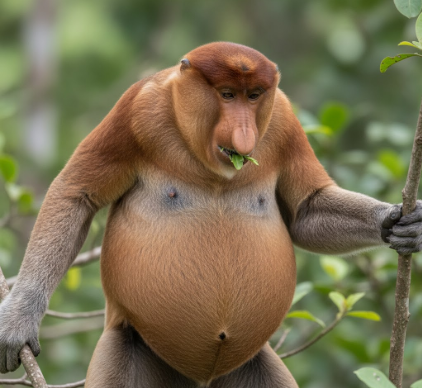
The stomach of a proboscis monkey is divided into chambers, much like a ruminant’s, though they’re not true ruminants. The largest chamber houses billions of symbiotic bacteria that ferment plant material, breaking down cellulose into short-chain fatty acids the monkey can actually absorb. This process generates heat—so much that proboscis monkeys often look bloated and move sluggishly after a big meal, their bellies visibly distended. I’ve seen footage of them sprawled out on branches like they’ve just finished Thanksgiving dinner, and honestly, they probably feel that way. The fermentation takes hours, sometimes stretching their stomachs to nearly 25% of their total body weight. That’s like a human walking around with a 40-pound gut full of fermenting salad.
Wait—maybe that’s why they’re so selective about what they eat? Despite living in forests dense with foliage, proboscis monkeys are picky. They prefer young leaves, seeds, and unripe fruits—foods that are easier to ferment and less toxic. Mature leaves contain higher concentrations of tannins and alkaloids, compounds that can interfere with digestion or even poison them.
Why Evolution Decided a Leaf Diet Was Worth the Bloating and Gas
The evolutionary trade-off here is stark. By specializing in leaves, proboscis monkeys avoid direct competition with other primates that rely on fruit. But they pay a price: their diet is so low-energy that they spend most of their day either eating or resting. They can’t afford rapid movement or high-energy activities like the acrobatics you see in other monkeys. Their social structures are relatively calm, their territories small. They’ve essentially become the sloths of the monkey world, though they’re not actually related to sloths at all.
I guess it makes sense when you think about it. If your stomach is a fermentation chamber, you’re not exactly built for speed.
The Bacterial Ecosystem That Makes Leaf-Eating Possible (And Smelly)
The bacteria in a proboscis monkey’s gut are incredibly specialized. Researchers have identified strains similar to those found in cows and other foregut fermenters, but with unique adaptations to the monkey’s specific diet. These microbes produce enzymes that break down cellulose, hemicellulose, and pectin—the structural components of plant cell walls. In return, the bacteria recieve a warm, stable environment and a constant supply of food. It’s mutualism at its finest, though it does come with side effects: proboscis monkeys are notoriously gassy. The fermentation process produces methane and other gases, which the monkeys must expel regularly. It’s not glamorous, but it’s necessary.
Honestly, I find it kind of remarkable that this system works at all.
What Happens When Their Forest Diet Gets Disrupted by Habitat Loss
Here’s where things get grim. Proboscis monkeys are critically endangered, their populations declining as Borneo’s mangrove and riverine forests are cleared for palm oil plantations and development. When their habitat shrinks, so does the diversity of their diet. They’re forced to eat lower-quality leaves, which their bacteria struggle to ferment efficiently. Malnutrition follows. Stress weakens their immune systems. Populations fragment and genetic diversity drops. The very specialization that allowed them to thrive in their niche now makes them vulnerable. You can’t just relocate a proboscis monkey to a new forest and expect it to adapt—it needs specific plant species, specific bacteria, and specific conditions to survive.
We’re watching an evolutionary marvel slowly disappear because we didn’t leave enough trees standing. It’s frustrating, and definately preventable, but here we are.
The Unexpected Link Between Nose Size and Stomach Function That Scientists Are Still Debating
There’s a weird hypothesis floating around in primatology circles: that the proboscis monkey’s enormous nose might be connected to its digestive system. Some researchers suggest the nose acts as a resonating chamber, amplifying vocalizations that males use to attract mates and signal dominance. But others think it might play a role in thermoregulation—helping dissipate the heat generated by all that fermentation. The jury’s still out. What we do know is that males with larger noses tend to have higher social status and more mating success, which implies the trait is sexually selected. Whether that’s independent of their stomach function or somehow linked remains an open question. Evolution doesn’t always connect the dots in ways we expect. Sometimes a big nose is just a big nose. Sometimes it’s a billboard advertising genetic fitness. And sometimes—maybe—it’s a cooling system for a perpetually overheated gut.
Anyway, I’m not sure we’ll ever know for certain.