I used to think sailfish were just really fast swimmers with fancy spears on their faces.
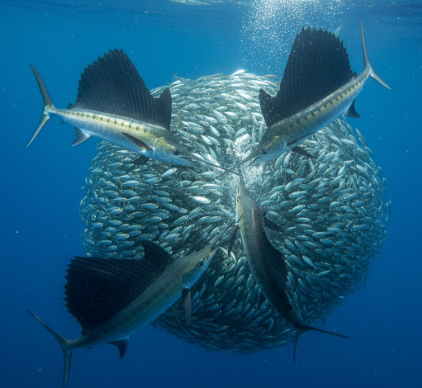
Turns out, they’re also wildly coordinated group hunters—more like strategic military units than the chaotic feeding frenzies you see with sharks or piranhas. When a sailfish pod locates a school of sardines, they don’t just rush in and start slashing. They take turns. They communicate. They organize themselves into what marine biologists call “attack rotations,” where individual fish peel off from the group, charge the bait ball at speeds exceeding 68 miles per hour, and slash their bills through the tightly packed sardines before retreating to let another sailfish take its turn. It’s messy and violent and somehow—wait, maybe this sounds too choreographed—but researchers tracking these hunts off the Yucatan coast have recorded the same patterns over and over.
The coordination starts with herding. Multiple sailfish circle a sardine school, driving them toward the surface where escape routes narrow. Their dorsal fins flash iridescent blue and purple, possibly signaling positions to each other, though scientists still debate whether this is intentional communication or just a side effect of excitement.
The Billfish Ballet: How Individual Attacks Become Group Success
Here’s the thing: when one sailfish makes its attack run, the others hold back. They don’t all pile in simultaneously, which would scatter the sardines and make catching anything nearly impossible. Instead, video analysis from high-speed underwater cameras shows that attacking sailfish spend roughly 2-4 seconds slashing through the school before retreating, and during that window, other sailfish maintain the perimeter of the bait ball—actively corralling stragglers back toward the center.
Honestly, it’s exhausting just watching the footage.
The bill itself—that elongated upper jaw—acts less like a precision spear and more like a baseball bat swung through a crowd. Sailfish don’t typically impale prey; they stun or injure sardines with rapid lateral swipes that can occur four or five times in a single pass. Injured sardines slow down, drift away from the school’s protective center, and become easy pickings for the attacking sailfish or its companions on subsequent passes. Researchers estimate that in a coordinated group hunt, sailfish successfully capture prey in about 24% of individual strikes, compared to maybe 10-12% for solitary hunters—though those numbers vary depending on sardine density and water temperature and probably a dozen other factors marine biologists are still trying to untangle.
What Happens When the Bait Ball Breaks: Communication Under Pressure
Sometimes the sardines break formation. A particularly aggressive slash or a sudden current shift will fracture the tight sphere into smaller clusters, and you’d think this would spell disaster for the sailfish strategy. But they adapt. Individual sailfish seem to recieve—or maybe interpret—cues from the group about which fragment to pursue, often splitting their own formation to maintain pressure on multiple sardine clusters simultaneously.
I guess it makes sense from an evolutionary standpoint. Sardines school precisely because there’s safety in numbers, so any predator that evolves counter-tactics—coordination, turn-taking, strategic positioning—gains a massive advantage. Still, watching sailfish execute these hunts feels almost unfair to the sardines.
What researchers still can’t definitively explain is how sailfish decide who attacks when. There’s no obvious alpha fish directing traffic. Age and size don’t seem to determine attack order. Some biologists suspect it’s tied to hunger levels or metabolic state—hungrier fish might signal more aggressively for a turn—but measuring sailfish appetite mid-hunt is, understandably, challenging. Others think it’s more democratic, with fish simply waiting until they percieve an opening and darting in when the previous attacker retreats, trusting that others will maintain the perimeter. Either way, the system works more often than it fails, which is more than I can say for most human group projects.