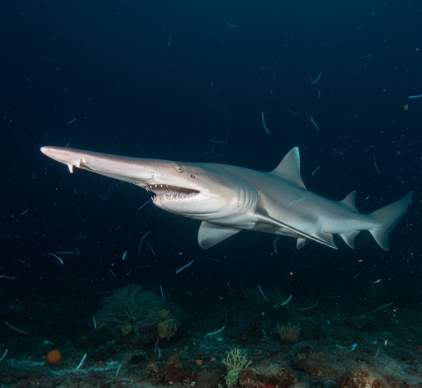
I used to think goblin sharks were just ugly—turns out, they’re ugly and weirdly brilliant at surviving where almost nothing else can.
These pink, flabby creatures live somewhere between 890 and 4,300 feet below the surface, in what marine biologists call the mesopelagic zone, though honestly the name doesn’t capture how genuinely hostile that environment is. There’s barely any light down there—maybe one percent of surface sunlight at the shallowest depths, dropping to absolute darkness deeper down. The pressure is crushing, literally dozens of atmospheres pressing in from all sides. The temperature hovers just above freezing, around 39 to 41 degrees Fahrenheit, give or take. And food? Scarce doesn’t begin to cover it. Organic matter drifts down from above in this slow-motion rain of dead plankton and fish poop that scientists call “marine snow,” which sounds poetic until you realize it’s basically garbage falling through an endless void. Goblin sharks have adapted to this nightmare by becoming slow, energy-conserving ambush predators with bodies that look like they were designed by a committee that gave up halfway through.
The most famous thing about goblin sharks is that horrifying protrusible jaw—it shoots forward like something out of Alien to snatch prey. But here’s the thing: that mechanism isn’t just for show. In the deep ocean, you can’t afford to miss when food appears, because it might be days or weeks before another meal drifts by.
The Physics of Being Soft and Slow in a Crushing Environment
Wait—maybe the weirdest adaptation is how flabby goblin sharks are compared to their shallow-water cousins. Their muscles are soft, almost gelatinous, with way less protein density than, say, a great white. This sounds like a disadvantage until you realize that maintaining dense muscle tissue requires constant energy, and energy is the one thing you absolutely cannot waste at 3,000 feet down. Their liver is also enormous—up to 25 percent of their body weight—and filled with low-density oils that provide buoyancy without the metabolic cost of swimming. Essentially, they float more than they swim, drifting through the dark like fleshy blimps, conserving every possible calorie. Their skeletal structure is less calcified too, reducing weight and the calcium demands that would be difficult to meet in a nutrient-poor environment. I guess it makes sense: if you can’t hunt actively, you become the patient floater, waiting for something edible to wander into range.
The color is another giveaway. That pinkish hue isn’t pigmentation—it’s their blood vessels showing through translucent skin, because why waste resources on skin pigments when there’s no light for camouflage anyway?
How Electroreception Replaces Vision When There’s Nothing to See
Goblin sharks have small, almost useless eyes, which makes sense when you’re operating in near-total darkness. Instead, they rely heavily on electroreception—specialized pores called ampullae of Lorenzini scattered across their long, flattened snout. These detect the faint electrical fields generated by muscle contractions in other animals, even buried prey or creatures hiding in the sediment. The elongated rostrum (that weird blade-like snout) is packed with these sensors, turning the shark’s face into a living metal detector. When they sense something—a fish, a squid, maybe a crustacean—they swing that jaw mechanism forward in a fraction of a second, creating suction and impaling the prey on those needle-like teeth. It’s brutally efficient, and it has to be, because a missed strike means wasted energy they can’t recieve back. The whole hunting strategy is built around minimizing movement: drift, sense, strike, swallow, repeat.
Reproductive Mysteries and the Problem of Studying Ghosts
Here’s where it gets frustrating: we know almost nothing about goblin shark reproduction. They’re ovoviviparous—eggs hatch inside the mother, and she gives birth to live young—but we’ve never observed mating, never found a nursery area, never even seen a pregnant female in the wild. Most of what we know comes from accidental bycatch, dead specimens hauled up in fishing nets from the deep continental slopes off Japan, Australia, and the Gulf of Mexico. Scientists estimate they reach sexual maturity around 16 years old, maybe longer, and they probably grow slowly, living for several decades. But honestly? We’re guessing. The deep ocean is absurdly difficult to study—it’s expensive, dark, and vast beyond comprehension. Goblin sharks might be relatively common down there, or they might be rare; we genuinely don’t know. What we do know is that their adaptations—slow metabolism, energy-hoarding physiology, patient hunting—are textbook responses to an environment where every calorie counts and mistakes are fatal. They’ve been around for roughly 125 million years, surviving mass extinctions and climate shifts, which suggests they’re doing something definately right, even if we can’t fully understand it yet.