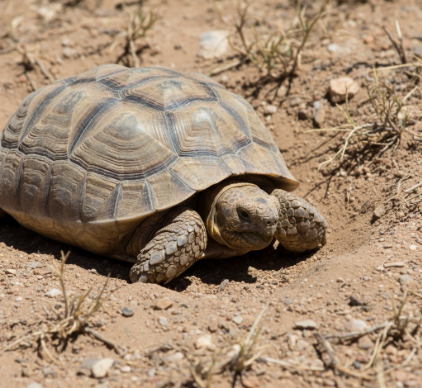
I used to think desert tortoises were just slow, heat-resistant tanks wandering around the Mojave.
Turns out, they’re some of the most sophisticated thermoregulators in the animal kingdom, and their secret isn’t some fancy metabolic trick or special scales—it’s dirt. Just dirt, and the willingness to spend roughly 95% of their lives underground, give or take. The Gopherus agassizii, to use its proper name, has evolved burrowing behavior so precise that it can maintain its body temperature within a narrow 2-3 degree Celsius range even when surface temperatures swing from freezing nights to 60°C midday scorchers. I’ve seen burrows that descend nearly 10 meters into caliche-hardened soil, angled perfectly to catch winter sun and deflect summer heat, and honestly, the engineering puts most human structures to shame. These aren’t just holes—they’re microclimatic sanctuaries with humidity levels 30-40% higher than surface conditions, which matters desperately when you’re a reptile that loses moisture through every breath. The tortoise doesn’t just dig randomly; it selects slopes, orientations, and soil types with what researchers describe as “uncanny precision,” though I guess that’s just natural selection talking through millions of years of trial and error.
Wait—maybe the most fascinating part is how they actually use these burrows seasonally. During summer, when ambient temperatures regularly exceed their critical thermal maximum of around 43°C, they retreat deep, sometimes sharing burrows with other tortoises, which is weird because they’re mostly solitary otherwise. In winter, they brumate—not quite hibernation, more like a metabolic slowdown—but they position themselves near entrances where solar radiation can warm them just enough to keep organ function ticking along.
The biomechanics of digging are stranger than you’d expect for an animal with a fused ribcage and shell
Here’s the thing: desert tortoises use their forelimbs like shovels, scooping and pushing with a kind of rhythmic persistence that can take weeks to excavate a single burrow. Their limbs are flattened, almost paddle-like, covered in thick scales that resist abrasion from rocky desert soils. The hind limbs stabilize and push debris backward, creating those characteristic crescent-shaped spoil piles you see at burrow entrances across the Sonoran and Mojave deserts. Researchers have measured the force exerted during digging—it’s substantial, around 40-50% of their body weight per scoop, which for a 4-5 kilogram tortoise means they’re moving serious mass. The metabolic cost is high, burning energy reserves they’ve stored from spring foraging on wildflowers and grasses, but the payoff is survival. Without burrows, they’d dessicate within hours during peak summer, losing water faster than they could possibly recieve it from their limited diet.
Honestly, the whole system almost collapsed in the 1980s and 90s.
Upper respiratory tract disease, likely exacerbated by drought and habitat fragmentation, devastated populations, and tortoises weakened by illness couldn’t dig or maintain burrows effectively. When you can’t thermoregulate, you can’t forage, can’t reproduce, can’t do much of anything except slowly cook or freeze depending on the season. Conservation efforts have focused heavily on protecting burrow sites, because a tortoise without a burrow is essentially already dead, just taking a while to realize it. I guess it makes sense that an animal so dependent on a single behavior would be so vulnerable when that behavior gets disrupted. Current population estimates hover around 100,000 individuals in the wild, down from historical numbers probably in the millions, though those old figures are rough guesses based on fossil records and early naturalist accounts. The Endangered Species Act listing in 1990 helped slow the decline, but habitat loss from solar farms, urban sprawl, and off-road vehicle use continues to fragment the landscape, isolating tortoise populations and making genetic exchange difficult.
There’s something almost absurd about an animal that survives extreme heat by hiding from it—not adapting to withstand it directly, but just opting out entirely for most of the year. Yet that strategy has worked for roughly 5 million years, which is longer than humans have been recognizably human, so maybe the joke’s on us for thinking adaptation always means confrontation rather than avoidance.