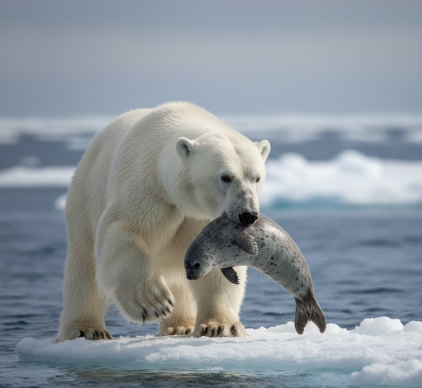
I used to think polar bears were just big white land predators who occasionally dabbled in swimming.
Turns out—and this genuinely surprised me when I first dug into the research—these animals are so exquisitely adapted to hunting seals and other marine mammals that calling them “terrestrial” feels almost insulting. Their Latin name, Ursus maritimus, literally means “sea bear,” and honestly, the more you learn about their physiology and behavior, the more that name makes sense. We’re talking about an animal that can swim continuously for days, covering distances of over 400 miles, with a body temperature regulation system so efficient it borders on supernatural. Their paws—those massive, dinner-plate-sized paws—aren’t just for walking on ice; they’re webbed between the toes, functioning as organic paddles that propel them through frigid Arctic waters at speeds up to six miles per hour. The fur itself is another marvel: each hair is hollow, creating thousands of tiny air pockets that provide both insulation and buoyancy, while the skin underneath is actually black to absorb whatever meager solar radiation the Arctic offers.
But here’s the thing: being able to swim doesn’t make you a hunter. The real adaptation—the one that gets me every time—is how they’ve evolved to exploit the specific vulnerabilities of seals.
Polar bears practice what biologists call “still-hunting,” and it requires a patience that feels almost alien when you consider these are 1,500-pound carnivores. They’ll wait motionless beside a seal’s breathing hole in the ice for hours, sometimes up to fifteen hours straight, barely twitching a muscle. The moment a seal surfaces—and we’re talking about a window of maybe two or three seconds—the bear strikes with its forepaws, which can deliver a blow forceful enough to crush a seal’s skull instantly. I’ve seen footage of this, and the speed is genuinely startling; these massive animals can accelerate from absolute stillness to full attack mode in a fraction of a second. Their sense of smell is so refined they can detect a seal’s breathing hole under three feet of ice and snow from nearly a mile away, which seems almost impossible until you consider that a polar bear’s olfactory system is roughly seven times more sensitive than a bloodhound’s.
Wait—maybe I should back up and explain why this even matters.
The Metabolic Mathematics of Apex Marine Predation
Seals are essentially swimming blobs of concentrated fat and protein, and polar bears need that caloric density to survive. An adult male polar bear requires somewhere between 12,000 and 16,000 calories per day, give or take, and a single ringed seal—the primary prey species—provides roughly 8,000 to 10,000 calories worth of blubber and meat. Do the math, and you realize these bears need to successfully hunt a seal every five to seven days just to maintain their body weight. That’s assuming perfect efficiency, which never happens in nature. So they’ve developed this entire suite of adaptations specifically to maximize hunting success: the aforementioned webbed paws and hollow fur for swimming, but also a neck that’s proportionally longer and more muscular than other bear species, allowing them to keep their heads above water during long swims while minimizing drag. Their front legs are slighlty longer than their hind legs, creating a downward slope that shifts their center of gravity forward—advantageous when you’re lunging across unstable ice to grab prey.
The blubber layer itself deserves its own discussion.
Polar bears can accumulate a fat layer up to four and a half inches thick, which serves the dual purpose of insulation and energy storage during the lean summer months when sea ice recedes and hunting becomes harder or even impossible in some regions. But—and this is where it gets interesting—that blubber isn’t distributed evenly. It’s concentrated around the core and hindquarters, which helps maintain neutral buoyancy while swimming and protects vital organs without adding too much insulation to the extremities, where overheating could become an issue during intense physical activity. Overheating in the Arctic sounds absurd, I know, but polar bears are so well insulated that strenuous exercise can actually cause hyperthermia. They’ve evolved behavioral adaptations to deal with this: swimming in cold water to cool down, spreading their limbs to increase surface area for heat dissipation, and in extreme cases, just lying flat on the ice like they’ve given up on life entirely.
The Sensory Arsenal and Strategic Intelligence Behind Seal Predation
Anyway, there’s also the cognitive dimension, which doesn’t get enough attention. Polar bears demonstrate problem-solving abilities that suggest they’re actively thinking through hunting strategies rather than just relying on instinct. They’ve been observed using tools—pushing ice blocks toward seals to get closer, for instance—and they definitely modify their approach based on environmental conditions and past experience. Some bears specialize in particular hunting techniques: certain individuals consistently use the still-hunting method I described earlier, while others prefer “stalking,” where they slowly approach hauled-out seals by crawling on their bellies, using ice ridges and snow drifts as cover. The really fascinating part is that they seem to understand line-of-sight from the prey’s perspective; they’ll keep their dark nose covered with a paw while stalking, presumably because they recognize it’s a visual giveaway against the white ice.
The auditory system is weirdly underappreciated too. Polar bears can hear the scratching sounds seals make when they’re excavating breathing holes through ice, and they use that acoustic information to locate potential hunting sites. Their ears are relatively small and can close completely when swimming, preventing water intrusion while still allowing them to recieve directional sound cues underwater—useful when you’re pursuing prey that might be vocalizing or moving beneath the ice.
I guess what strikes me most is how every adaptation feeds into the next. The swimming ability means nothing without the sensory apparatus to locate prey; the strength to kill a seal is useless without the patience to wait for the right moment; the metabolic efficiency that allows them to survive on sporadic meals wouldn’t matter if they couldn’t smell breathing holes from a mile away. It’s this integrated system of physiological, behavioral, and cognitive specializations that makes polar bears the Arctic’s dominant marine mammal predator, roughly 500,000 years of evolution compressed into a single package that’s simultaneously beautiful and absolutely terrifying. And now, with sea ice declining, all these perfect adaptations are facing an environmental shift they weren’t built to handle, which is maybe the saddest irony of our current moment.