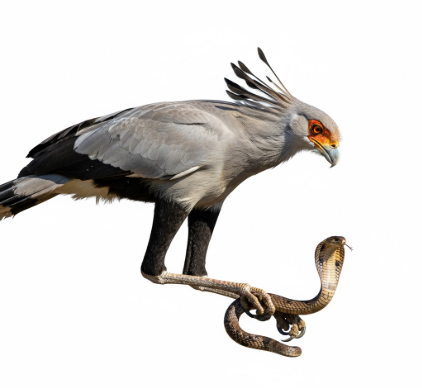
I used to think secretary birds were just tall, awkward-looking raptors with weird leg feathers until I saw footage of one stomping a snake to death.
These birds—Sagittarius serpentarius, if you want the Latin—are the only living members of their family, which honestly makes sense when you look at them. They stand nearly four feet tall on stilt-like legs, which is bizarre for a raptor, and they hunt by walking. Not flying down to grab prey like every other bird of prey, but literally marching across the African savannah for miles, sometimes covering 20 miles in a day, just looking for something to kick. Their hunting method is so strange that for years scientists debated whether they even belonged in the raptor family at all, though genetic studies from the early 2000s confirmed they’re related to hawks and eagles, just wildly divergent. The feathers jutting from the back of their heads supposedly reminded early European settlers of the quill pens secretaries used to tuck behind their ears—hence the name, which feels almost too literal.
Here’s the thing: those legs aren’t just for show. Secretary birds deliver kicks with a force of roughly five times their body weight, striking in less than 15 milliseconds. That’s faster than you can blink, literaly.
Why Walking Instead of Flying Makes Them Lethal Snake Killers
Most raptors hunt from above because it works—spot prey, dive, grab with talons, done. Secretary birds rejected that entire playbook. They hunt on foot because their primary prey, venomous snakes, are dangerous to grab. A puff adder or cobra can strike back if you’re holding it, but if you’re stomping on its head with the force of a small sledgehammer, it doesn’t get that chance. Researchers at the University of Antwerp measured these kicks and found they deliver around 195 Newtons of force—enough to crush a snake’s skull or spine instantly. The birds also have thick scales on their legs, which offer some protection against bites, though they mostly avoid getting bitten by keeping their distance and using those absurdly long legs as weapons.
Anyway, they don’t only eat snakes. They’ll take lizards, rodents, insects, even other birds if the opportunity presents itself, but snakes make up a significant chunk of their diet in the wild.
The Evolutionary Mystery of Their Unique Body Plan and Hunting Style
Nobody really knows why secretary birds evolved this way. The fossil record for their family is sparse—there are a few fragments from the Miocene epoch, roughly 15 million years ago, give or take, but nothing that clearly explains how they ended up looking like a crane crossed with an eagle. One theory is that their ancestors lived in grasslands where walking was more efficient than flying for finding scattered prey, and over time they just got really, really good at kicking things. Another idea is that their long legs let them see over tall grass, giving them a hunting advantage in open savannahs. What we do know is that they’ve been doing this for a very long time, and it works well enough that they haven’t needed to change.
Wait—maybe the weirdest part is that they’re the only raptors that hunt primarily on the ground as adults. Sure, some owls or hawks will occasionally walk after prey, but secretary birds basically never hunt from the air.
How Their Stomping Technique Actually Works in Real Time
When a secretary bird spots a snake, it doesn’t rush in. It approaches carefully, then suddenly launches a kick—or more accurately, a stomp—with one leg extended forward. The impact is brutal and precise, aimed at the head or neck. If the first kick doesn’t kill the prey, the bird keeps stomping, sometimes dozens of times, until the snake stops moving. They also use their wings for balance during these attacks, spreading them wide to stabilize themselves, which makes the whole thing look like some kind of deranged martial arts move. Occasionally they’ll grab the snake with their beak and throw it into the air before stomping it again, though researchers aren’t entirely sure why—maybe to disorient it, maybe just because they can.
Conservation Status and Why We Should Care About These Bizarre Birds
Secretary birds are currently listed as Endangered, which surprised me when I first learned it. Their range across sub-Saharan Africa is shrinking due to habitat loss—grasslands being converted to farmland, mostly—and they’re also vulnerable to poisoning from pesticides that accumulate in their prey. They’re not heavily hunted, but they reproduce slowly, typically raising only one or two chicks per year, which makes population recovery difficult. Some conservation groups are working to protect remaining grassland habitats, but it’s hard to prioritize a bird most people have never heard of, even if it does have one of the most metal hunting strategies in the animal kingdom.
I guess it makes sense that something this specialized would be fragile. When your entire survival strategy depends on wide-open spaces and an abundance of snakes, you don’t have much room for adaptation.