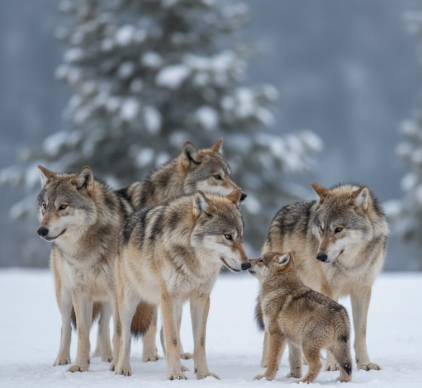
I used to think wolf packs were like corporate boardrooms—some alpha strutting around, chest puffed, barking orders at cowering subordinates.
Turns out, that whole framework is basically fiction. The “alpha wolf” concept came from a 1947 study by Rudolph Schenkel, who observed wolves in captivity at the Basel Zoo in Switzerland. He watched unrelated wolves crammed together in artificial enclosures, competing for resources, and assumed this reflected natural behavior. But here’s the thing: captive wolves behave nothing like wild ones. It’s like studying human family dynamics by watching strangers fight over the last seat on a subway. Schenkel’s wolves were stressed, confined, and forced into hierarchies that don’t exist in the wild. The researcher who popularized the term “alpha,” L. David Mech, spent decades trying to undo the damage, publishing corrections in 1999 and beyond, but the myth had already infected everything from business seminars to dating advice.
Wild wolf packs aren’t dominance pyramids. They’re families. The “alphas” are just parents—a breeding pair leading their offspring, usually pups and yearlings from previous litters. The father and mother coordinate hunts, choose den sites, and discipline rowdy kids, exactly like human parents do, minus the minivan. There’s no violent overthrow, no constant jockeying for position. When young wolves reach maturity, around two or three years old, they typically leave to find mates and start their own packs. It’s more “leaving for college” than “Game of Thrones.”
The Myth That Ate the World and Why It Felt So Right
So why did the alpha myth stick? Honestly, it’s embarassingly simple: it justified our own hierarchies. If wolves—noble, wild, apex predators—operated on dominance, then maybe human power structures were “natural” too. Corporate consultants loved it. Pick-up artists loved it. Even dog trainers used it to sell harsh techniques, insisting owners needed to “dominate” their pets. The myth felt true because we wanted it to be. We projected our anxieties about status, control, and masculinity onto animals who were just trying to raise their kids and catch elk.
The irony? Real wolf behavior is way more interesting.
Mech’s field research in Minnesota and the Canadian Arctic revealed that wild packs operate on cooperation, not coercion. The breeding pair—let’s call them what they are, mom and dad—make decisions collaboratively, often deferring to each other based on context. The mother might lead when choosing a den; the father might take point during a hunt. Subordinate wolves aren’t submissive out of fear—they’re literally the kids, following their parents because that’s how survival works when you’re learning to hunt 400-pound ungulates. Aggression is rare. When it happens, it’s usually a parent correcting a pup, not some ritualized dominance display. Pack cohesion depends on trust and affection, which researchers observe through grooming, play, and coordinated howling. Wolves that don’t cooperate don’t last long. The environment kills them first.
What This Means for the Rest of Us Living With Dogs and Bad Metaphors
The collapse of the alpha myth has real consequences. Dog training has slowly shifted away from dominance-based methods—choke chains, “alpha rolls,” yelling—toward positive reinforcement, because dogs, descended from wolves, don’t actually think in terms of pack hierarchy either. They think in terms of resources, safety, and whether you’re fun to be around. Modern ethologists like Alexandra Horowitz emphasize that dogs aren’t trying to “dominate” you when they pull on the leash; they’re just excited about smells. The alpha framework was always a misunderstanding, and it caused decades of unnecessary conflict between humans and their pets.
I guess it’s worth asking: what else have we gotten wrong by forcing animals into narratives that comfort us? Wolves aren’t the only victims of anthropomorphic projection. We’ve done it to apes, dolphins, lions, even ants. We see competition because we’re obsessed with competition. But wild wolf packs—quiet, cooperative, structured around love and survival rather than domination—offer a different model. Not one that’s «better» or more moral (wolves aren’t moral agents), but one that’s truer. And maybe that’s enough. Maybe the lesson isn’t that wolves are noble or virtuous, but that they’re complicated, like everything else that lives. And we owe them the effort to see them clearly, without our baggage.
Anyway, the next time someone invokes “alpha” energy, maybe send them a link to Mech’s 1999 paper.