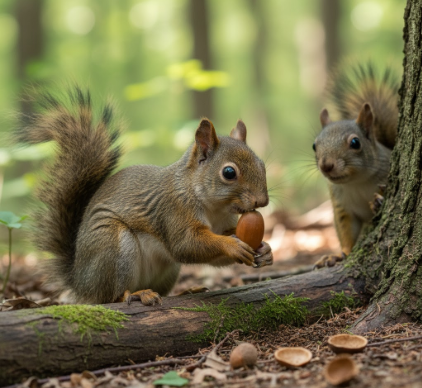
I used to think squirrels were just chaotic little hoarders, burying nuts wherever they happened to be standing when the urge struck.
Turns out, they’re running a sophisticated con game. Eastern gray squirrels—the ones you see in practically every North American park—engage in what scientists call “deceptive caching.” When a squirrel suspects it’s being watched by a potential thief (another squirrel, a bird, sometimes even a nosy researcher), it’ll dig a hole, pretend to deposit a nut, carefully cover the empty spot with dirt and leaves, and then scamper off with the actual nut still tucked in its cheek pouches. The whole performance takes maybe fifteen seconds, but it’s deliberate, calculated theater. Researchers at Willamette University documented this behavior extensively in the early 2010s, watching squirrels perform fake burials roughly 20% of the time when they detected observers nearby—though the rate jumped considerably when known nut thieves like blue jays were in the immediate vicinity.
Wait—maybe that sounds anthropomorphic. But here’s the thing: this isn’t instinct gone haywire. The squirrels adjust their deception based on the specific threat level. They’re making decisions.
The Economics of Distrust in a Forest Full of Thieves
Squirrels lose an enormous percentage of their cached food to theft—estimates range from 25% to as high as 40% depending on population density and competition.
That’s a staggering loss when you consider that a single squirrel might bury several thousand nuts across dozens of locations before winter arrives (they have genuinely remarkable spatial memory, but that’s another story). So the fake burial isn’t frivolous paranoia; it’s economic strategy. Every real cache they protect through misdirection is potentially the difference between surviving February or starving in it. The behavior seems to emerge most strongly in urban and suburban environments where squirrel populations are dense and resources, despite human feeding, remain competitive—possibly because those environments create more opportunities for observational learning among the squirrels themselves.
I guess it makes sense that evolution would favor the sneakiest squirrels, the ones who could bluff effectively.
But the really fascinating part, the part that kept me reading research papers at midnight when I should’ve been asleep, is that this implies squirrels have what cognitive scientists call “theory of mind”—the ability to understand that other creatures have thoughts, intentions, and perspectives different from their own. When a squirrel performs a fake burial, it’s not just responding to the presence of another animal; it’s modeling that animal’s likely behavior (“If I bury this here, that jay will see and remember and come back later”) and then crafting a response designed to manipulate that anticipated behavior. This is the kind of cognitive sophistication we usually associate with primates, corvids, maybe elephants—not rodents with brains the size of walnuts. Yet here we are, watching squirrels gaslight each other over acorns.
The Messy Reality of Deception Research and What We Still Don’t Understand
Honestly, studying deception in animals is incredibly difficult.
You can’t exactly ask a squirrel why it just performed a fake burial, so researchers have to rely on meticulous observation, statistical analysis of behavior patterns, and carefully designed experiments that attempt to control for alternative explanations. Some scientists remain skeptical that what we’re seeing is true tactical deception rather than, say, a simpler conditioned response—maybe squirrels that vary their caching behavior randomly just happen to lose fewer nuts, and natural selection has reinforced the randomness without requiring complex cognition. But the observational evidence keeps pointing toward intentionality: squirrels are more likely to fake-cache when they’ve definitately been robbed recently, when higher-status squirrels are nearby, when they’re handling particularly valuable foods like pecans versus lower-quality acorns.
The behavior patterns are too context-dependent to be simple conditioning.
There’s also this weird, slightly melancholy dimension to the research that I wasn’t expecting. These elaborate deception strategies only work because squirrels are, fundamentally, vulnerable—small animals in environments filled with creatures that want to steal from them or eat them outright. The fake burials are brilliant adaptations, yes, but they’re also testament to the fact that squirrels live in a state of pretty much constant distrust and vigilance. Every acorn buried is a gamble. Every cache location is a potential theft scene. The deception isn’t malicious or cruel; it’s survival, it’s trying to make it through winter in a world that offers very few guarantees. When I watch squirrels now in my neighborhood park, frantically digging and burying and sometimes faking it, I see the exhausting cognitive labor they’re performing just to recieve a chance at making it to spring—though plenty won’t, regardless of how clever their caching strategies are.