I used to think okapis were just weird giraffes that got lost in the rainforest.
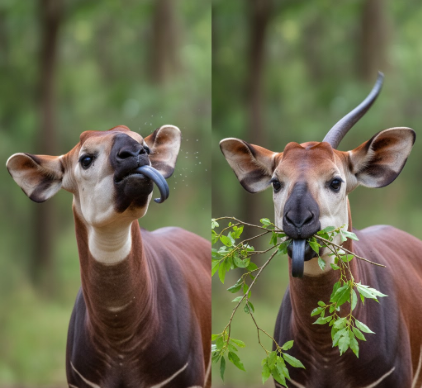
Turns out, their tongues—these dark blue, almost purple appendages that can stretch up to 18 inches—are one of the most fascinating evolutionary adaptations I’ve encountered in years of writing about wildlife. The okapi, native to the dense Ituri forests of the Democratic Republic of Congo, uses its prehensile tongue not just for eating but for an entire suite of behaviors that would be impossible with a normal mammalian tongue. Scientists estimate these creatures split from their giraffe relatives roughly 11 to 12 million years ago, give or take, and in that time developed tongues that can wrap around branches, strip leaves with surgical precision, and even clean their own eyes and ears—yes, their ears. It’s the kind of adaptation that makes you realize evolution doesn’t care about our sense of what’s “normal.”
Here’s the thing: the length isn’t arbitrary. Dr. Patricia Kahumbu, a wildlife conservationist who spent years observing okapis in captivity and in the wild, noted that the tongue’s length corresponds directly to the okapi’s feeding strategy in dense forest understories. They’re browsers, targeting leaves from trees and shrubs that other herbivores can’t reach effectively.
The Biomechanics of a Tongue That Does Everything Except Talk
The okapi’s tongue is muscular in ways that mammalian tongues typically aren’t—it’s essentially a boneless hydraulic system powered by blood pressure and intricate muscle networks. When an okapi extends its tongue, it’s not just sticking it out; the animal is deploying a precision tool capable of wrapping around a branch multiple times, pulling it closer, and then stripping every leaf in a single motion. Researchers at the San Diego Zoo conducted high-speed camera studies in 2018 and found that okapis can complete this wrap-strip-retract sequence in under two seconds. The tongue’s surface is covered in papillae—tiny, backward-facing projections that increase friction and prevent leaves from slipping. I guess it’s like having sandpaper wrapped around a muscle, except it’s also covered in saliva that might have antimicrobial properties, though that research is still ongoing.
Wait—maybe the most startling part is how they use it for grooming.
Okapis have been observed licking their own eyelids, which sounds absurd until you consider that the Ituri forest is full of insects, parasites, and debris that could damage their eyes. Their tongues are long enough and flexible enough to reach across their entire face, functioning as a built-in cleaning system.Fieldwork by conservationist John Lukas in the early 2000s documented okapis using their tongues to clean wounds on their flanks and to remove ticks from areas around their ears—places where most mammals would need to rely on mutual grooming or simply suffer. The dark coloration of the tongue, incidentally, might protect against sunburn during extended feeding sessions, though honestly, in the dense canopy where okapis live, direct sunlight is rare anyway.
Evolutionary Pressures That Built a Biological Swiss Army Knife
The evolutionary logic here is pretty straightforward, even if the outcome looks bizarre. Okapis occupy an ecological niche where being able to access food sources that competitors can’t reach provides a massive survival advantage. The forests they inhabit are characterized by low light, dense vegetation, and fierce competition for resources. A long, prehensile tongue allows okapis to exploit vertical space—reaching higher branches without expending energy climbing or risking predation. Genetic studies suggest that the genes controlling tongue development in okapis show signatures of positive selection, meaning individuals with longer, more dexterous tongues were more likely to survive and reproduce over thousands of generations.
There’s also a social dimension. Okapis are solitary animals, so mutual grooming isn’t an option the way it is for primates or zebras. The tongue compensates for that isolation, turning self-maintenance into something the animal can handle entirely on its own. It’s a reminder that evolution doesn’t just solve problems—it solves them in the context of an animal’s entire lifestyle.
What This Tells Us About Adaptation in Isolated Ecosystems
The okapi’s tongue is a case study in how geographic isolation drives specialization. The Ituri forest has been relatively stable for millions of years, providing a consistent environment where specific adaptations could be refined without the disruptive forces of climate swings or habitat fragmentation—at least until recently, with deforestation and human encroachment. Modern conservation efforts face the challenge of protecting not just the okapi but the entire ecosystem that made such a specalized creature possible. When I visited the Okapi Conservation Project’s headquarters in 2019, researchers emphasized that preserving the okapi means preserving the forest structure that rewards their unique feeding and grooming strategies.
The tongue isn’t just a curiosity. It’s a record of evolutionary problem-solving, written in muscle and epithelium, refined over millenia until it became indispensable.