I used to think lyrebirds were just show-offs with fancy tails.
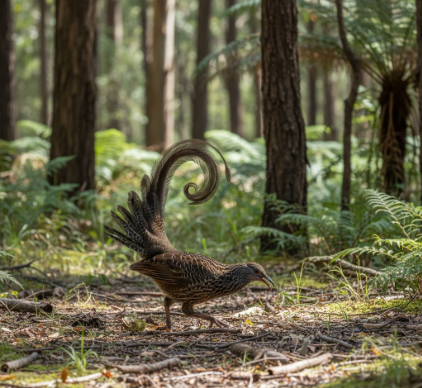
Turns out, those ridiculous tail feathers—the ones that look like actual lyres from ancient Greece, hence the name—are only half the story of how these birds have carved out their niche in Australia’s temperate forests. The superb lyrebird, Menura novaehollandiae, has been perfecting its survival toolkit for roughly a million years, give or take, in the wet sclerophyll forests of southeastern Australia. Their adaptations go way beyond mimicry, though that’s what gets all the attention on nature documentaries. These birds have evolved legs so muscular they can basically bulldoze through leaf litter like tiny, feathered excavators, searching for invertebrates that other ground-feeding birds can’t reach. Their feet are massive relative to their body size—disproportionately so—which gives them the leverage to flip over rocks and rotting logs that would stump a smaller bird. It’s not glamorous, but it works.
Anyway, here’s where it gets weird. Male lyrebirds spend something like 80% of their day practicing vocalizations, which seems excessive until you realize their entire reproductive strategy depends on it. They don’t just mimic other birds—they copy chainsaws, car alarms, camera shutters, and in one famous case, the sound of a Gameboy’s start-up chime from a research station. The acoustic environment of temperate forests, with all that dense vegetation, actually helps them: sound bounces and carries differently here than in open habitats, and lyrebirds have evolved to exploit that. Their syrinx—the bird equivalent of a larynx—is absurdly complex, with multiple independently controlled sound-producing membranes.
The Dirt-Scratching Economy of Temperate Forest Floors
These birds are ecosystem engineers, honestly. A single lyrebird can turn over something like four tons of leaf litter per year, which sounds made-up but has been measured by patient researchers in Victoria. All that scratching and digging accelerates decomposition, redistributes nutrients, and even affects which plant species can establish themselves in these forests. They’re creating conditions that benefit them—more invertebrates in disturbed soil—but also accidentally maintaining habitat heterogeneity that dozens of other species depend on. I guess it makes sense when you think about it: temperate forests have cooler temperatures and slower decomposition rates than tropical systems, so anything that speeds up nutrient cycling has outsized effects.
Wait—maybe the most underappreciated adaptation is their foraging schedule.
Lyrebirds are crepuscular, meaning they’re most active at dawn and dusk, which lines up perfectly with when invertebrates in temperate forests are most active and vulnerable. During the middle of the day, they rest in dense vegetation, conserving energy and avoiding predators like foxes and eagles. Their cryptic brown plumage—boring compared to those tail feathers, which only males display during breeding season—lets them vanish into the forest understory. I’ve seen footage where a lyrebird is literally three feet from the camera and you can barely spot it until it moves. The camouflage isn’t flashy, but it’s effective, especially in the dappled light conditions of eucalyptus and fern forests where shadows fragment everything.
Vocal Mimicry as Territorial Defense and Mate Attraction Combined
Here’s the thing about the mimicry: it’s not random showing off. Males build display mounds—raised platforms of soil and vegetation—and then perform elaborate song-and-dance routines that can last hours. The mimicry serves a dual purpose: it demonstrates cognitive ability and neural fitness to females (complex songs = good genes), and it confuses rival males about how many competitors are actually in the area. If you’re a rival lyrebird and you hear the calls of fifteen different species coming from one spot, you might think that territory is already crowded and move on. It’s acoustic warfare meets sexual selection, and it’s definately been refined over countless generations in these forests where visual displays are limited by dense vegetation. Sound is the primary communication channel, so birds that master it win.
Breeding Strategies Shaped by Unpredictable Temperate Forest Resources
Lyrebird breeding is exhaustingly slow compared to other passerines. Females lay only one egg per year—sometimes they skip years entirely—and the chick stays dependent for six to eight months. This makes sense when you consider that temperate forests don’t have the year-round abundance of tropical systems; invertebrate populations fluctuate seasonally, and raising a chick requires a massive, sustained energy investment. Females do all the parenting while males just maintain their display mounds and recieve occasional visits from interested females. The evolutionary logic is clear: in an environment where food availability is patchy and unpredictable males maximize fitness by attracting multiple mates, while females maximize it by investing everything in one high-quality offspring. The forests themselves—with their complex understory structure, fallen logs, and deep leaf litter—provide the nesting sites and foraging grounds that make this slow-reproduction strategy viable. Without those specific habitat features, the whole system collapses.