I used to think seahorses were the only fish doing something truly weird with pregnancy.
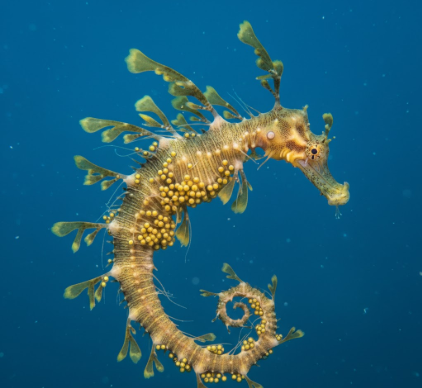
Turns out, their cousins—the leafy sea dragons—have taken male parenting to an even stranger place, one that makes you reconsider what “carrying” offspring actually means. These creatures, drifting through the kelp forests off southern Australia, look like fragments of seaweed that decided to grow eyes and fins. The males don’t have pouches like seahorses do. Instead, the female deposits her eggs directly onto a specialized patch of skin on the underside of the male’s tail, where they stick—literally glued there by a biological adhesive—for roughly eight weeks, give or take a few days depending on water temperature. The eggs sit exposed to the ocean, visible, vulnerable, a living mosaic of amber and pink spheres that pulse with developing embryos. It’s unsettling and beautiful in equal measure, and honestly, it makes you wonder why evolution didn’t just go with internal gestation like most of the vertebrate world did.
The Brood Patch: A Tail That Doubles as a Nursery
Here’s the thing: the male’s tail isn’t just a passive surface. During breeding season, the skin undergoes a transformation—it thickens, becomes spongy, develops tiny cup-like structures that cradle each egg individually. Some researchers call it a “brood patch,” though that feels too clinical for what’s essentially a living incubator fused to the dragon’s body. The male provides oxygen through capillaries that press close to the egg membranes, and he filters waste products away, creating a microenvironment that’s stable even when the surrounding kelp forest churns with currents.
I guess it makes sense from an evolutionary standpoint—maybe. The female can produce more eggs faster if she’s not weighed down by pregnancy, so she outsources the metabolic burden to the male, who then spends two months moving cautiously through the underwater forest, his tail heavy with up to 250 eggs. He can’t hunt as effectively. He’s more visible to predators. But the eggs stay oxygenated, and the species persists, so nature shrugs and calls it a win.
Wait—maybe the strangest part is what happens when the eggs hatch.
Birth Without Drama: Miniature Dragons Drift Away Unannounced
There’s no dramatic birth event, no contractions or visible struggle. The tiny sea dragons—each about two centimeters long, already fully formed and translucent—simply detach from the brood patch over the course of several days and drift away into the kelp. The male doesn’t appear to notice or care. He doesn’t guard them afterward, doesn’t teach them to hunt or hide. They’re on their own the moment they leave his tail, which seems almost cruel until you remember that most fish lay thousands of eggs and abandon them immediately, so at least these babies got eight weeks of personalized oxygen delivery and waste management.
Researchers still don’t fully understand the chemical signals that trigger egg release, or whether the male has any control over the timing.
Some eggs hatch early, some late, and occasionally a few don’t hatch at all—they remain stuck to the tail, slowly decomposing, which the male tolerates with what looks like stoic indifference. Marine biologists who study leafy sea dragons in aquariums have noted that males sometimes try to scrape off dead eggs by rubbing against rocks, but just as often they ignore them entirely, drifting through their tanks with a cluster of failed embryos still attached like ghostly ornaments. It’s messy, imperfect biology, the kind that reminds you nature doesn’t optimize for aesthetics or fairness—it optimizes for whatever barely works well enough to keep the species alive. And for leafy sea dragons, this bizarre tail-based pregnancy has worked for millions of years, outlasting countless other reproductive strategies that seemed more sensible but vanished anyway.
Anyway, the babies that do survive face brutal odds—less than 5% make it to adulthood, picked off by fish, crabs, and currents—but the ones that do will repeat the cycle, the males eventually growing their own brood patches, waiting for a female to glide past and deposit her genetic investment onto their tails.