
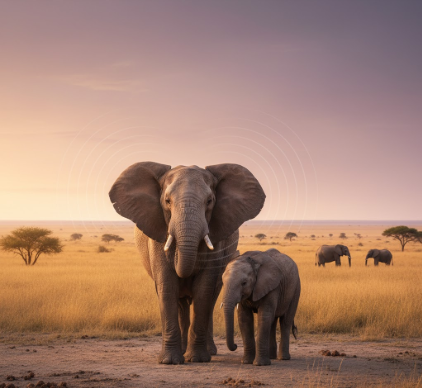
I used to think elephants were just, you know, big gray things that remembered stuff.
Turns out they’re operating an entire communication network we can’t even hear—a subsonic rumbling system that works like some kind of biological telegraph across miles of African savanna. These infrasonic calls, vibrating at frequencies below 20 Hz (well beneath human hearing range), let elephant herds coordinate movements, warn about predators, and even flirt across distances that would make your cell phone provider jealous. The physics are almost absurdly elegant: low-frequency sound waves travel farther because they lose less energy to atmospheric absorption, and elephant vocal anatomy—those massive larynxes, the resonating chambers in their foreheads—evolved specifically to exploit this. Research from Cornell’s Elephant Listening Project has documented calls traveling up to 6 miles through open terrain, maybe more under ideal conditions, and the elephants aren’t just broadcasting randomly; they’re encoding information about identity, emotional state, reproductive status, and threat levels into durational patterns and harmonic structures that other elephants can definately parse.
The Anatomy of a Rumble That Shakes the Ground Beneath Your Feet
Here’s the thing: elephant infrasound isn’t just airborne. When a matriarch produces one of these calls—contracting muscles around a larynx the size of a small watermelon—the sound radiates through air, sure, but it also couples into the ground as seismic waves. Other elephants detect these vibrations through mechanoreceptors in their feet and trunks, essentially “hearing” through bone conduction and pressure-sensitive cells. Caitlin O’Connell-Rodwell’s work at Etosha National Park showed elephants responding to playback calls transmitted only through substrate vibration, which is wild when you think about the evolutionary pressure that refined this dual-channel system. The feet of an elephant have fatty pads that act like biological seismometers, and they’ll often freeze mid-stride, lifting one foot slightly, when recieving distant signals—a posture researchers call “listening behavior.”
I guess it makes sense that an animal weighing 6 tons would use the earth itself as a transmission medium. Anyway, the calls aren’t uniform; there’s a whole vocabulary emerging from decades of observation.
What Elephants Actually Say When We’re Not Listening Closely Enough
Wait—maybe “vocabulary” is too strong, but there are distinct call types. “Contact calls” help separated family members reunite, often produced by calves or females checking in across a few hundred meters. “Let’s go” rumbles, identified by Joyce Poole and colleagues, precede coordinated group movements and have this rising frequency contour that seems almost interrogative, like the matriarch is asking consensus. Then there are estrus calls from females in breeding condition—these can attract bulls from over 2 miles away, which honestly sounds exhausting for everyone involved. Males produce their own “musth rumbles” when testosterone-flooded and looking for receptive females, and these are lower, longer, more pulsed than female calls. The acoustic parameters matter: a 2003 study in Animal Behaviour found elephants could distinguish individual callers based on formant frequencies and durational patterning, suggesting they maintain mental maps of who’s where based purely on infrasonic chatter they’re monitoring constantly.
Why This Matters Beyond Just Thinking Elephants Are Cool and Impressive
Conservation implications are significant.
Human infrastructure—roads, fences, mining operations—introduces low-frequency noise that masks elephant communication, essentially jamming their channels. A highway cutting through migratory routes doesn’t just physically block movement; it drowns out the infrasonic coordination that makes group cohesion possible across fragmented landscapes. There’s also evidence that elephants modify calling behavior in noisier environments, increasing amplitude or shifting frequency ranges, which costs metabolic energy and may reduce reproductive success if females can’t advertise estrus effectively or if matriarchs can’t maintain herd structure during resource-scarce dry seasons. Katy Payne, who basically founded this field after noticing a throbbing sensation near elephants at a zoo in the 1980s, has argued that protecting acoustic habitat—the soundscape itself—is as crucial as protecting physical territory. I’ve seen footage of elephants standing motionless for minutes, clearly processing information from calls we’d need spectrogram analysis to even detect, and it drives home how much of their world operates in sensory dimensions we’re oblivious to unless we build the right instruments.
The Messiness of Studying Something You Cannot Hear Without Expensive Equipment
Field research on infrasound is technically annoying. Standard audio recorders miss most of it; you need specialized microphones with extended low-frequency response, seismic sensors for substrate vibrations, and lots of batteries because you’re recording continuously in remote areas where elephants actually live. Early studies relied on analog equipment that degraded in heat and humidity, and researchers spent years just establishing that these calls existed and weren’t, like, distant thunder or truck engines. Even now, there’s debate about maximum transmission distances—environmental variables like temperature gradients, wind, terrain topology all affect propagation in ways that are hard to model precisely. Some estimates put effective range at 10 kilometers under optimal atmospheric conditions, but “optimal” basically never happens in reality. Plus elephants are moving targets; you’re trying to triangulate sound sources from animals that walk 30 kilometers a day while simultaneously accounting for Doppler shifts and multipath reflections off rock formations. Honestly, the fact that we know anything solid about this system is a testament to decades of patient, unglamorous fieldwork by people comfortable with mosquitos and equipment failures.
The science is still messy, still full of unknowns, but that’s what makes it feel real.